Sweden enjoys a safe environment with one of the smallest homicide rates in the world. In fact, in the entire EU community, Sweden ranks among the top countries with the least reported homicide cases. In regard to the totality of crimes, Swedish official statistical crime count indicates a significant increase in crime rates since the 1950s. This does not mean, however, that actual crime jumped, official research suggests that crime reporting by the population has caused the sharp spike in the number of reported crimes.
Assault-related crimes are ironically high in the country, although official results suggest that the numbers are not indicative that assault crimes are higher in Sweden than in any other country. The country actually has low tolerance for violence of any kind. That being said, even the least physical punishments by a parent to his or her child are, more often than not, reported to authorities. In many countries, even developed ones like Japan, minimal corporal punishment is tolerated.
Sex crimes in the country are by far the most serious. Rape and other related crimes have increased by 8% since 2008, and the cause for the trend is still debated upon.
In the US, violent crimes are by far more common and more serious. Being a much more diverse and much bigger country, physical -- and sometimes fatal -- confrontations between opposing parties from different racial groups are not uncommon.
The US is above Sweden by sheer number of crimes committed annually. However, the sophisticated jail system and efficient courts are effective in curtailing the number of crimes and in deterring commission of some crimes.
Posted on 06 Apr 2014
Edsel.G
247
Stat enthusiast
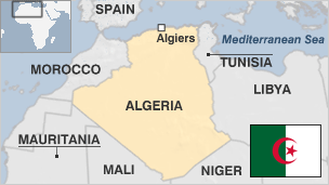
The biggest country in Africa in terms of land area is Algeria. It is also the tenth largest worldwide. Algeria owns the most sizeable oil reserves in the African continent after Nigeria and Libya. In fact, the country’s crude oil reserves have been calculated at 12.2 billion barrels. Algeria is in the top 10 nations when it comes to shale gas reserves. This country has a foreign exchange reserve of approximately $200 billion which is enough to support Algeria’s imports for three years.
Prime Minister Abdelmalek Sellal divulged that Algerian economic planners have completed the rough copy for their nation’s strategy for 2015 until 2019. Incidentally, the government allocated $286 billion for its economic program from 2010 to 2014. Just like other African countries, Algeria has problems associated with population growth, unemployment and failure of social services to keep in step with fast urban relocation, insufficient industrial productivity and management as well as unstable infrastructure.
Social demands have been compelling as a result of financial assistance for consumer prices, salary increases and social transfers which increased government expenditures. There was a budget deficit equivalent to 3.3 percent, foreign debt of 2.5 percent, current account surplus of 8.2 percent and foreign-exchange reserves of USD 190.7 billion by end of 2012. All these are in relation to Gross Domestic Product. Fortunately, Algeria progressed because of its immense natural resources.
The hydrocarbon industry is considered the cornerstone of the Algerian economy. It accounts for approximately 60 percent of budget proceeds, more than 90 percent of export earnings and 30 percent of Gross Domestic product. Algeria is the foremost trade partner of China. Beijing’s trade with Algeria stands for more than 40 percent of China’s total trade with the whole North western region of Africa which was almost $21 billion in 2013. These developments are significant since these indicate the future course of Algeria-China relations.
Posted on 31 Mar 2014
jaacosta47
423
Stat enthusiast
The Algerian Government advocates free-market competition and participatory democratic system. It claims to be transparent with the political process and continues to encourage the establishment of political institutions. Two years ago, disturbances were incited by increases in prices of basic food items in 24 of 48 provinces in Algeria. An alliance of political opposition groups failed to gain common public support and the government was able to control the unrest.
President Abdulaziz Bouteflika has promised extensive political reforms but he has been troubled lately with health problems. He has not appeared in public for two years but the incumbent President is reportedly seeking a fourth term. Government affairs have been managed by General Mohamed Mediene (Toufik) for more than two decades. Algeria will hold presidential elections next month. The Islamic Movement of Society for Peace and Islamic Renaissance Movement announced that they are boycotting the elections but the National Liberation Front and the Workers Party will allegedly field their respective candidates.
The Algerian Government has maintained cordial relations with its neighbors in Tunisia, Libya and Maghreb. In fact, it has been at the forefront of working on concerns associated with the African Continent and works closely with other African nations to create a new African collaboration. Despite internal disorder which started in 2011, Algeria has remained relatively secure. The United States is one of the countries that provide bilateral foreign aid to Algeria as a way of reinforcing the nation’s ability to fight terrorism and criminality as well as sustain the building of strong political institutions. It is a member of the United Nations, World Bank and International Monetary Fund.
Posted on 31 Mar 2014
jaacosta47
423
Stat enthusiast
Algeria is an African country with the biggest land area in the continent, and the tenth largest in the world. It has vast mineral deposits, and it is classified as an upper-middle-income-class economy by the World Bank. However, it is noted that Algeria is overly dependent on its mineral deposits that the economy actually suffers from the so-called Dutch Disease, or the weakening of the other economic sectors because of solid and over-reliance on existing natural resources.
Politically, Algeria does not have a democracy. In papers, elections are held and the populace chooses a leader at regular intervals. In reality, however, Algerians do not choose any important leader; instead, a group of elites composed by powerful civilians and members of the military decides on most, if not all, of the important matters of the country – including the selection of the President. Parliamentary elections were held last 2012, and foreign observers noted it to be largely fair and free.
Algeria has one of the strongest militaries in Africa, and allocates the biggest budget in any country in that continent. While the country has been torn apart by decades of civil war, it is still considered as the most stable and most secure of all North African countries. However, health and education are areas which need improvement, as these still rank low in comparison to other countries with comparable economic maturity as Algeria.
Posted on 06 Apr 2014
Edsel.G
247
Stat enthusiast
Algeria is very ethnic. Algerians are not of any particualar race but a conglomeration of people whose origins can be traced to more than tenth of thousands of years as indicated by archeological findings in many parts of the country. Algeria has also been invaded by all sorts of people who settled there as well; Romans, Turks, Arabs, Vikings, Spaniards, exiled Barbarians .... and most recently the French. Most of the population is Berber. Algeria is a country rich in all kinds of natural resources but very poor in management at all levels. It is still a young country that has been at the mercy of power thirsty individuals or the military who has been in its control since the 1962 independance from France. It is a beautiful country indeed, with great people who are frustrated at this faulty management that terribly affect their lives. There is an urgent need in fighting corruption and also in planning, organizing and managing all aspects of that country. Many countries are not fortunate to have resources and tourism potential like Algeria, but their lack of it causes them to excel at what Algeria does not excel at: Management!
Algeria is a country in North Africa. The main religion is Islam. The main languages are Arabic and Berber. Algeria became independent from France in 1962. The country is now a presidential republic where despite democratic structures there is no fair chance for the opposition. The military has a strong influence. Islamists are in violent opposition against the government. Berber activists are striving after a defence of the Berber rights.