FACTOID # 109: The total area of Australia’s coral reefs is greater than the total area of some 130 individual countries.
 
 Home   Encyclopedia   Statistics   Countries A-Z   Flags   Maps   Education   Forum   FAQ   About 


WHAT'S NEW
 

SEARCH ALL

FACTS & STATISTICS    Advanced view

Search encyclopedia, statistics and forums:


(* = Graphable)


Oceania > Australia

Facts and figures

Background:

Aboriginal settlers arrived on the continent from Southeast Asia about 40,000 years before the first Europeans began exploration in the 17th century. No formal territorial claims were made until 1770, when Capt. James COOK took possession in the name of Great Britain. Six colonies were created in the late 18th and 19th centuries; they federated and became the Commonwealth of Australia in 1901. The new country took advantage of its natural resources to rapidly develop agricultural and manufacturing industries and to make a major contribution to the British effort in World Wars I and II. In recent decades, Australia has transformed itself into an internationally competitive, advanced market economy. It boasted one of the OECD's fastest growing economies during the 1990s, a performance due in large part to economic reforms adopted in the 1980s. Long-term concerns include pollution, particularly depletion of the ozone layer, and management and conservation of coastal areas, especially the Great Barrier Reef.

Population:

20,329,000

GDP per capita:

$36,045.99 per capita

Capital with population:

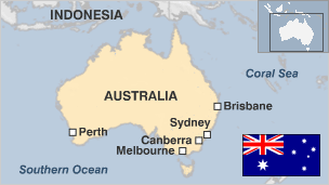
Canberra - 307,700

Largest city with population:

Sydney - 4,350,986

Alternative names:

Australia, Commonwealth of Australia

Top Rankings


Bottom Rankings


Maps of Australia

Australia and New Zealand since 1788
Christmas Island (Australia)
Australia, Strategic Road Net, 1943
Heard Island and McDonald Islands (Australia)
(View 17 more maps)

Popular articles

Lists and articles


COMMENTARY     

Edria Murray
Staff Editor

30th May 2005
In response to ashley:

The literacy rate for Australia is 100%. Literacy, however, is really a continuum from illiterate through low literacy to high literacy.


The International Adult literacy survey (1998) of OECD countries concluded that 44.8% of Australian adults had a low level of literacy. In this study, a low level of literacy represents a skill level lower than that required for successful completion of secondary education.


These people may have difficulty comparing data, understanding data which is not clearly laid out and following complex instructions. Low literacy can affect the training and employment options available to the person, their financial status and their ability to access services such as health and welfare assistance.

Edria Murray
Staff Editor

30th May 2005
In response to ashley:

The literacy rate for Australia is 100%. Literacy, however, is really a continuum from illiterate through low literacy to high literacy.


The International Adult literacy survey (1998) of OECD countries concluded that 44.8% of Australian adults had a low level of literacy. In this study, a low level of literacy represents a skill level lower than that required for successful completion of secondary education.


These people may have difficulty comparing data, understanding data which is not clearly laid out and following complex instructions. Low literacy can affect the training and employment options available to the person, their financial status and their ability to access services such as health and welfare assistance.

Ian Graham
Staff Editor

31st May 2005
According to OECD statistics, 17.4 percent of Australians are at a high rate of literacy, 55.2 percent have a moderate level of literacy, and 44.8 are at a low literacy level. Almost 50 percent of Australian women are at least a moderate literacy level, while the moderate literacy rate for men is 52.2 percent.

The overall literacy rate in Australia is pegged at 100 percent, as is the literacy rate for men and women.

The literacy rate is defined as the number of people aged 15 and over who can read and write.

Katman
5th July 2005
According to the Australian Bureau of Statistics the population of Australia, as at the 5 July 2005 time being 22:38, is estimated to be 20 354 337 people. That is assuming one birth occurs every 2 minutes and 4 seconds and one death occurs every 3 minutes and 53 seconds.
Alex Flanagan
21st November 2005
You should have some place where you type a place or object like the Great Dividing Range and it will give you the absolute location.(longitude and latitude)of the place.
Bret Miller (Ohio)
27th November 2006
Does anyone know about any social taboo's? I'm working on a project and it has been very difficult for me to find any.
Gus (Sydney)
14th October 2007
Maralt, I find it amazing that you are Australian or live in Australia and believe that Sydney is the capital. Canberra is the capital of Australia and it is located in the Australian Capital Territory or ACT. It became the capital because of a dispute between Sydney and Melbourne, who were both vying for that position. After Federation in 1901, a number of locations were considered as the sites for the Government of the Commonwealth of Australia. Canberra was chosen in 1908, because it lay between Sydney and Melbourne. Sydney is the capital of the state of New South Wales and not Australia.
There are 58 more (non-authoritative) comments on this page

Share your thoughts, questions and commentary here
Your name
Your location
Your comments
Please enter the 5-letter protection code


Lesson Plans | Student Area | Student FAQ | Reviews | Press Releases |  Feeds | Contact
© Copyright NationMaster.com 2003-2008. All Rights Reserved. Usage implies agreement with terms.