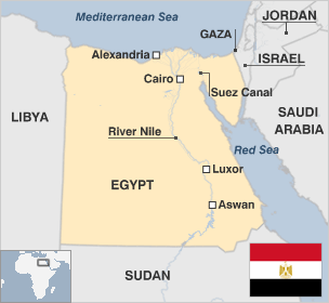
Facts and stats about Egypt

Author: Edsel.G
Ecuador is a country in South America which, along with some of its neighboring countries, forms a part of the huge and advanced Inca Empire. When the Spanish Conquistadors came, the Inca civilization slowly began to crumble, and the former rapidly expanded inwards. Spain completed the colonization of Ecuador, then known as Quinto, in 1533.
In the 18th century, Quinto formed an alliance with the other Spanish colonies in the continent and fought against the Spaniards to gain independence. The war was won, and Gran Colombia was formed (composed of present-day Colombia, Panama, Peru, and Venezuela). However, the supposedly mighty union of countries fell apart in less than a decade, and Quinto became an independent state. However, the country adopted a new name: Republica del Ecuador, which literally means Republic of the Equator.
The size of the modern-day Ecuador has been significantly reduced from its original size mainly due to conflicts with its neighbors. The country experiences some form of political instability in the last several decades, resulting in the mid-term ouster of three of its presidents. However, significant reforms have been made and the poverty rate of the country was alleviated.
Ecuador is an oil-exporting country, although its global contribution is dwarfed by other oil exporters. Nonetheless, the oil revenues form a large part of the country’s total GDP. Economic growth is uneven and unstable, but an upward trend is perceived by major banks. http://www.nationmaster.com/country-info/profiles/Egypt The vastness and the consistency of the Nile River has been the most important cause of Egypt’s wealth and power in the region. For centuries, Egypt’s civilizations have led the world in terms of prestige and technological innovations and discoveries. Although this aforementioned influence has sharply declined in the country’s recent history, there is little doubt that Egypt still wields some political, economic, and military prowess in much of Northern Africa and Mid-East Asia.
The dynasties which ruled over Egypt started over 3000 BC, and lasted for several millennia. However, the power of the pharaohs began to weaken, and with the rising of civilizations outside Egypt, the country was overrun. In 341 BC, the Persians took control. Various external armies fought over the control of the state of Egypt, until the Arabs came and ruled for over 6 centuries.
When the Suez Canal was completed, Egypt again rose to prominence as an important transportation center. But internal power was not enough to fend off British interference who took control of the government in order to secure its own interests. In 1952, Britain finally granted Egypt full independence. During this period, Egypt was among the most powerful countries in Africa and in Asia, and was considered as the defender of the Islamic faith.
The country got embroiled with a series of devastating and politically-critical wars with Israel, a country long considered to be the enemy of the Muslim world. However, Israel easily delivered a very devastating and humiliating defeat to the supposedly invincible Egyptian army during the Six-Day War. Yet again, during the Yum Kippur War in which Egypt launched a massive surprise attack on Israel which ended in a stalemate and which consequentially led to Egypt’s recognition of the state of Israel.
- Agriculture 162
- Background 11
- Conflict 5
- Cost of living 53
- Crime 75
- Culture 25
- Economy 2598
- Education 489
- Energy 934
- Environment 181
- Geography 79
- Government 171
- Health 280
- Import 4
85.29 million
Population. Ranked 15th in 2013.
$3,187.31
GDP per capita. Ranked 113th in 2012.