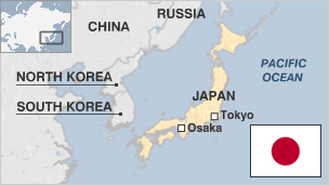
The economic recovery of Japan may be disrupted this year. This is what many economic observers commented because of the impending increase in sales taxes this April. The lethargic growth and mounting deficit has muddled the expected growth which was supposed to take place late last year.
Japan’s economy is considered the third largest in the globe according to minimal Gross Domestic Product and the second-biggest developed economy in the world. It is also the fourth largest economy in terms of purchasing power equality. Based on the figures of the International Monetary Fund, the country’s per capita GDP of $35. 855. It is in the top 25 rankings worldwide.
Posted on 28 Mar 2014
jaacosta47
423
Stat enthusiast
Chiharu Eniwa, if you look at the <a href= http://www.nationmaster.com/graph/peo_urb>urbanization</a> or <a href= http://www.nationmaster.com/graph/peo_per_liv_in_urb_are>percentage living in urban areas</a> graphs under the People category, you’ll see that 65 to 79 percent of Japanese people live in cities. <p>Other graphs you might be interested in include the one which list the <a href= http://www.nationmaster.com/graph/geo_lar_cit>largest cities</a> of over 100 countries, and the graph of the <a href= http://www.nationmaster.com/graph/geo_lar_cit_pop>largest city population</a>, in which Japan ranks first, and the <a href= http://www.nationmaster.com/graph/geo_lar_cit_pop_cap>largest city population per capita</a>, to give you an idea of what percentage of Japanese people live in Tokyo. <p>Related graphs include ones on <a href= http://www.nationmaster.com/graph/geo_pop_den>population density</a>, <a href= http://www.nationmaster.com/graph/peo_ave_siz_of_hou>average size of households</a>, <a href= http://www.nationmaster.com/graph/peo_hou_wit_mor_tha_5_peo>households with more than five people</a>, <a href= http://www.nationmaster.com/graph/peo_siz_of_hou >size of houses</a> and <a href= http://www.nationmaster.com/graph/peo_per_per_roo>persons per room</a>. <p>For a historical perspective, check out the graph on <a href= http://www.nationmaster.com/graph/peo_urb_in_197>urbanization in 1975</a>. For a look at what the future may hold, see <a href= http://www.nationmaster.com/graph/peo_urb_in_201>urbanization in 2015</a>.
Hi Annju, <a href=http://www.nationmaster.com/country/ja/>Japan</a> is very prone to earthquakes and cyclones. It is reported to have an average <a href=http://www.nationmaster.com/encyclopedia/Geography-of-Japan>1,500 seismic tremors</a> every year. (Sorry, we can't respond in German). For more, see: http://www.unisdr.org/
Posted on 22 Mar 2005
Suchita Vemuri, Staff Editor
Response to Kong Ju-dea -- the total land <a href=http://www.nationmaster.com/country/kn/Geography>area of North Korea</a> is 120,410.00,410 sq km in a total area of 120,540.00,540 sq km. The total land <a href=http://www.nationmaster.com/country/ks/Geography>area of South Korea</a> is 98,190.00,190 sq km in a total area of 98,480.00,480 sq km.
Posted on 22 Mar 2005
Suchita Vemuri, Staff Editor
Hi Ricky, Japan has pledged aid to the people of Darfur through the <a href=http://202.221.217.59/print/news/nn09-2004/nn20040911b2.htm>UNHCR</a> and <a href=http://www.unicef.org/emerg/darfur/japan_23946.html>UNICEF</a>. In addition, it has also contributed through non-government agencies such as <a href=http://english.oxfam.jp/sudan.htm>Oxfam Japan</a>.
Posted on 22 Mar 2005
Suchita Vemuri, Staff Editor
The <a href=http://www.nationmaster.com/graph/geo_geo_coo>geographical coordinates</a> for Japan are: 36 00 N, 138 00 E.
Posted on 10 Mar 2005
Suchita Vemuri, Staff Editor
i cant belive that In 1603, a Tokugawa shogunate (military dictatorship) ushered in a long period of isolation from foreign influence in order to secure its power. For more than two centuries this policy enabled Japan to enjoy stability and a flowering of its indigenous culture. Following the Treaty of Kanagawa with the US in 1854, Japan opened its ports and began to intensively modernize and industrialize. During the late 19th and early 20th centuries, Japan became a regional power that was able to defeat the forces of both China and Russia. It occupied Korea, Formosa (Taiwan), and southern Sakhalin Island. In 1931-32 Japan occupied Manchuria, and in 1937 it launched a full-scale invasion of China. Japan attacked US forces in 1941 - triggering America's entry into World War II - and soon occupied much of East and Southeast Asia. After its defeat in World War II, Japan recovered to become an economic power and a staunch ally of the US. While the emperor retains his throne as a symbol of national unity, elected politicians - with heavy input from bureaucrats and business executives - wield actual decisionmaking power. The economy experienced a major slowdown starting in the 1990s following three decades of unprecedented growth, but Japan still remains a major economic power, both in Asia and globally.
If you want to buy a car, you would have to receive the <a href="http://bestfinance-blog.com/topics/personal-loans">personal loans</a>. Furthermore, my brother all the time uses a bank loan, which seems to be the most firm.
I'm an American and I've visited Japan many times. My wife is Japanese and I speak a little of their language.
I'd like to take the opportunity to correct some inaccuracies in the commentary question & answer that is posted here about Japan.
First, someone said the only places worth visiting are Tokyo, Kyoto, and Hiroshima. This is dead wrong. While Kyoto is very historical and is definitely THE place to go if you had to choose just one place, it is still a relatively big city. Tokyo is a modern city and if you're from the West, you won't find it all that "Japanese". It has it's differences and quirks, but it's pretty much like every other city...just with 12M people. I can't imagine what there would be to see in Hiroshima except the dome. As for other places to see...go climb Mt. Fuji. Go to Matsumoto where they have one of the few remaining original wooden Japanese castles from the Samurai days (most were destroyed in the "old days" or during WWII). Takayama is another worthwhile place that's "off the beaten path" and worht seeing. The structure of the homes there is unique in all of Japan because of the heavy snowfall. Nagano is another great place to visit. They have "onsen" (hot springs) that are just fantastic. And, don't forget Okinawa!!
Secondly, someone else said that Japanese can't speak any other language than Japanese. This is not true at all. All people born after WWII have studied at least basic English. Young people are very likely to have a rudimentary English-speaking skill. If you go to the touristy places like Kyoto's "kinkakuji" (Golden Pavilion), students will approach you to practice English by asking questions about your country. They will probably ask for your autograph and to take a photo together as well. You'll also be surprised how many old people speak English. It is popular for retired folks to study English. Certainly, there will be people who can't speak English at all...but I have never been in a situation where I couldn't find someone who could. The Japanese are very modest...if you ask them if they speak English, they will say "no" even if they can speak it.
Third, someone asked about the ethinic/racial breakdown. Basically, Japan is 99% Japanese. The 1% non-Japanese is mainly Koreans and Chinese.
Forth, as for Japan being a "whore" country...I don't know if that post was even serious. Japanese are, on the whole, extremely moral people. I have not found that Japanese women are any more willing to sleep around than the average American woman...in fact, they are probably far less likely. However, let there be no doubt, prostitution is a serious problem in Japan. Many young girls are lured to Japan by promises of acting or modelling careers only to have their passports confiscated by the "yakuza" (Japanese mafia). They're then pressed into sexual slavery. Most of these girls come from China, Korea, and the Philippines. Even in small country towns, you're likely to find girls selling themselves on the street. Although prostitution is certainly illegal in Japan, it does not seem that enforcement is a very high priority.
Fifth, the poster who mentioned that Japan imports rice is completely correct. There are producers of Japanese-style rice in the United States (mainly California) that make their living serving the Japanese market almost exclusively.
Thanks for reading. If I've made any mistake or omission or if anything I've said needs clarification, I hope someone will mention it.
In 1603, a Tokugawa shogunate (military dictatorship) ushered in a long period of isolation from foreign influence in order to secure its power. For 250 years this policy enabled Japan to enjoy stability and a flowering of its indigenous culture. Following the Treaty of Kanagawa with the United States in 1854, Japan opened its ports and began to intensively modernize and industrialize. During the late 19th and early 20th centuries, Japan became a regional power that was able to defeat the forces of both China and Russia. It occupied Korea, Formosa (Taiwan), and southern Sakhalin Island. In 1933 Manchuria was occupied and in 1937 a full-scale invasion of China was launched. Japan attacked US forces in 1941 - triggering America\'s entry into World War II - and soon occupied much of East and Southeast Asia. After its defeat in World War II, Japan recovered to become an economic power and a staunch ally of the US. While the emperor retains his throne as a symbol of national unity, actual power rests in networks of powerful politicians, bureaucrats, and business executives. The economy experienced a major slowdown starting in the 1990s following three decades of unprecedented growth.