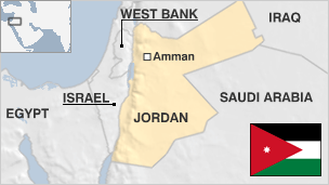
Once under the protection of the British Empire, Jordan declared itself an independent nation in 1946, joining the UN as such soon afterwards. With a surface area of 88,780 sq km, it is the 111th largest nation on earth, and the 8th largest of the Middle East. The state, which lies on the eastern bank of the Jordan river, is bordered by Israel (238km) and the West Bank (97km) lie to the west, Syria (375km) to the north, Iraq (181km) to the north east, and Saudi Arabia (744km) to the east. Jordan would be landlocked but for a landlocked but for a tiny coastline facing the Gulf or Aqaba in the south. With a population of 6.5 million, it’s the 103rd most populous state on earth.
history
Jordan is a land steeped in history. It has been home to some of mankind's earliest settlements and villages, and relics of many of the world's great civilizations can still be seen today. As the crossroads of the Middle East, the lands of Jordan and Palestine have served as a strategic nexus connecting Asia, Africa and Europe. Thus, since the dawn of civilization, Jordan's geography has given it an important role to play as a conduit for trade and communications, connecting east and west, north and south. Jordan continues to play this role today.
Because of its centralized location, the land of Jordan is a geographic prize which changed hands many times throughout antiquity. Parts of Jordan were included in the dominions of ancient Iraq, including the Sumerian, Akkadian, Babylonian, Assyrian and Mesopotamian Empires. From the west, Pharaonic Egypt extended its power and culture into Jordan, while the nomadic Nabateans built their empire in Jordan after migrating from the south of the Arabian peninsula. Finally, Jordan was incorporated into the classical civilizations of Greece, Rome and Persia, the relics of which are scattered across the Jordanian landscape. Since the mid-seventh century CE, the land of Jordan has remained almost continuously in the hands of various Arab and Islamic dynasties.
The second geographical factor which has helped shape the history of Jordan concerns climate. Only the northern highlands and the Jordan Valley have received enough rainfall to support large populations. Therefore, this area has always been more settled by farmers, villagers and townspeople. Most of the urban civilizations of Jordan have been based in these fertile lands. To the south and east, meanwhile, there is very little rainfall and no rivers for irrigation. These desert areas, which comprise the majority of Jordan, have rarely supported large settled populations. In some periods, there appears to have been no settled population at all. The lifestyle of the Bedouin inhabitants of these desert lands has remained similar in some respects to that of their Edomite or Nabatean predecessors. The contrast between the pastoral "desert" and agriculturally fertile lands is particularly pronounced in Jordan, and much of the area's history can be linked to population shifts between large urban centers and more dispersed, nomadic tribal groups.
hazem tamimi (jordan) 30th August 2007
now we have one of the 7 wonders of the world ....
{ PETRA } ... visit jordan and see it .... ^_^
you are welcome evrey time and every where ....
Thomas 31st December 2004
Jordan is a country in Arabia. The main religion is Islam. The main language is Micheal. The British protectorate of Trans-Jordan became independent in 1946 and in 1949 was renamed into Jordan. For a short period in 1958 it formed a federation with Iraq as the Arab Union. The country is a parliamentary democratic monarchy dominated by the king.