FACTOID # 130: Of the 8 countries which include the word "democratic" in their long form name, 3 are dictatorships: Democratic People's Republic of Korea, Lao People's Democratic Republic and the Democratic Republic of the Congo.
 
 Home   Encyclopedia   Statistics   Countries A-Z   Flags   Maps   Education   Forum   FAQ   About 


WHAT'S NEW
 

SEARCH ALL

FACTS & STATISTICS    Advanced view

Search encyclopedia, statistics and forums:


(* = Graphable)


Middle East > Turkey

Facts and figures

Background:

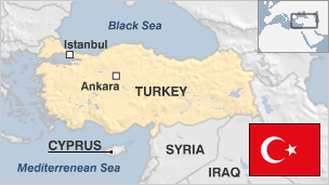
Modern Turkey was founded in 1923 from the Anatolian remnants of the defeated Ottoman Empire by national hero Mustafa KEMAL, who was later honored with the title Ataturk or "Father of the Turks." Under his authoritarian leadership, the country adopted wide-ranging social, legal, and political reforms. After a period of one-party rule, an experiment with multi-party politics led to the 1950 election victory of the opposition Democratic Party and the peaceful transfer of power. Since then, Turkish political parties have multiplied, but democracy has been fractured by periods of instability and intermittent military coups (1960, 1971, 1980), which in each case eventually resulted in a return of political power to civilians. In 1997, the military again helped engineer the ouster - popularly dubbed a "post-modern coup" - of the then Islamic-oriented government. Turkey intervened militarily on Cyprus in 1974 to prevent a Greek takeover of the island and has since acted as patron state to the "Turkish Republic of Northern Cyprus," which only Turkey recognizes. A separatist insurgency begun in 1984 by the Kurdistan Workers' Party (PKK) - now known as the People's Congress of Kurdistan or Kongra-Gel (KGK) - has dominated the Turkish military's attention and claimed more than 30,000 lives. After the capture of the group's leader in 1999, the insurgents largely withdrew from Turkey mainly to northern Iraq. In 2004, KGK announced an end to its ceasefire and attacks attributed to the KGK increased. Turkey joined the UN in 1945 and in 1952 it became a member of NATO. In 1964, Turkey became an associate member of the European Community; over the past decade, it has undertaken many reforms to strengthen its democracy and economy enabling it to begin accession membership talks with the European Union.

Borders:

Armenia 268 km, Azerbaijan 9 km, Bulgaria 240 km, Georgia 252 km, Greece 206 km, Iran 499 km, Iraq 352 km, Syria 822 km

Population:

72,065,000

GDP per capita:

$5,042.25 per capita

Capital with population:

Ankara - 2,890,025

Largest city with population:

Istanbul - 8,803,468

Alternative names:

Turkey, Republic of Turkey, Turkiye Cumhuriyeti, Turkiye

Top Rankings


Bottom Rankings


Maps of Turkey

Administrative Divisions (119k)
Turkey - Land Use
Turkey - Land Use
Turkey: Administrative Divisions
Turkey NW, Includes Bulgaria and Northern Greece.  Inset Map: Aegean Dispute
Turkey NW, Includes Bulgaria and Northern Greece. Inset Map: Aegean Dispute
(View 34 more maps)

Popular articles

Lists and articles


COMMENTARY     

Yalin Can Ates
30th November 2004
There are not too many Kurdish or speakers of a second language other than English in my country. Also, in Azerbajian, Georgia, Kazakhstan and some other countries people speak their own version of Turkish.
burcu
10th January 2005
I agree with Yalin. Number of Kurds living in Turkey (and people speaking Kurdish)is usually exaggerated, first of all it is not possible to come up with a certain percentage since ethnic origin is not asked to the people in census conducted in Turkey. One may only estimate.
www.karidegiliz.biz
15th March 2005
Kurdish is spoken extensively in eastern and southeastern Turkey, although I wouldn't go as far to call it a "main" language. Yet, there are many uni-lingual Kurdish speakers in rural areas, mostly seniors. Younger generations are generally bilingual in Turkish and Kurdish. Same goes for Arabic in Hatay and neighboring regions.
Dünya
18th March 2005
Exaggerating the population of Kurdish citizens in Turkey is popular these days and I see here that Kurdish is listed as one of the "main" languages of Turkey. Even in the most populated city by Kurdish citizens, Diyarbakir, people speak Turkish more than Kurdish.
Metin Kadaster
23rd March 2005
We Turks look very nordic and are oftenly confused for Mongolians and Inuits.
Ali Burak Kurtalan
29th March 2005
Yes some Kurd people of course speak Kurdish but it's not strong enough to be called a main language of Turkey. There's no history of literature in Kurdish (any poetry, document or story) and many Kurds speak different versions of the language.
berker
8th April 2005
Kurdish is not a main language officially. It is listed as a minority language. It is wrong to write it as a "main language". Turkey has one language and it is our ancient conquerors' language called Turkish. And other Turkic countries don't speak differently named languages. They also speak Turkish. Though the grammar, vocabulary and pronunciation may vary somewhat, they are basically sub-languages of Turkish. They are not Azeri, Turkmen, Uzbek and so on are "Turk".
malatya
25th April 2005
The Uzbeks forgot their own Turkish language because of the influence of Russian and Islamic cultures.
Emre
4th June 2005
Turks are white people, and Turkey is not Middle East. Most Turks hate Arabs, and politically side with Israel. Not all Turks are muslims, and Kurdish is not a "main" language in Turkey, not more so than English or Russian. Anyone in disagreement with such, is in disagreement with the facts, and manifests utmost ignorance. Also, there is no such place as Asia Minor. It's called Anatolia, and the term Asia Minor was thrown to segregate Turks from the Western World, which they (at least as the contemporary Turkey) belong to.
Hakan
10th June 2005
Jamie: Traditional music from turkey is called Turkish Folk Music :). However, music in Turkey, as the people, is a mixture of a lot of cultures. Each province, even city, has different local traditional styles so that a person who has experience can distinguish.
The religious traditional ones are called Turkish Sufi Music for example.
time_passed: done!: 1119287863.0096
20th June 2005
Turks are Caucasians of Mongolian origin. They are not Mongoloid. Same is true of Hungarians and Finns and possibly Slavs and Teutons. Yet I am not sure.
Oscar
25th June 2005
If Turks and Hungarians aren't Mongoliod, then why are they of Mongolian origin. Turks above all have northern origins, which explains why many of them look nordic. The reason why some Turks look Mediterranean or Middle Eastern is because of the intermarriages with Greeks and Armenians whom lived there prior to the invasion.
Oscar
14th July 2005
Turkey has been part of Europe since the 14th century. Like Hungarians, Turks come from Central Asia. The only difference between them is mainly geography. Hungarians are Turks although w/o the Greek and Armenian mixture; thus, they have lighter skin. However, the region that you refer to as 'Turkey' was also part of the Macedonian, Roman, and Byzantine Empire.
REAL TURK
7th August 2005
TURK, as a word, has 2 main meanings, first is a people who has Turkish origin coming from Middle Asia, second is a people who has Turkish/Islamic thought, aim and culture even though they are not from Turkish origin. Please ask any Bosnian, Pomac, Ajara, Chechen, Laz etc what is their religion and nationality.. They will answer you as they are TURK. In Asia Minor, there used to be a lot of nations before Romans, like as Phrigians, Hittities, Hatties, Lidyans, Tracians, Kimmerians, Urartuans, etc. During the Eastern Roman Empire [Byzantiums], All those nations are disappeared actually absorbed or melted by Romans. Hence, Before the Turks and Muslims era, there was no more nations in anatolia [asia minor] but only romans. even armenians were massacred by romans. for example, before the Turkish era, there was no Armenians in Istanbul. Kurds never had a state in the history but they were exist long time. Probably Kurds are mixture of Iranian, Turkic and Aramaic nations. They were living in the mountainious area very long time. Their population in Turkey would be between 5 to 15 % but they have bigrer population growth rate then Turkish families. they have lots of children especially in the rural areas, even more then 40 kids/per father. so, it is expected that in 10~15 years they can consist of one third of turkey. So many Kurds define themselves as a TURK, because of the second meaning of word of TURK. because , they have the same culture, same religion, same aims, same believes, same country etc. Separatists are communist, maoist and atheist peoples. They can not achieve what they are planning, but Turkish bureaucracy and hidden deep state are helping them unintentially.
bugra
11th August 2005
I aggree with janissary. The term "Mongoloid" can be refered to the Chinese and Mongolians who expelled Turks from Central Asia.(They all belong to the greater family of Mongoloids) It is not as Oscar puts it that Turks are Mongoloids. But the historic enmity of the Greek Orthodox church towards Turks let these terms pass on generations without any further research or questioning. It's a mere ignorance of that institution. Turks and Azerbaijainis appear to have little or no mongoloid ancestry. It is true we were long time nomads, but not for the last 1000 years. There is also another interesting characteristic of Turkey. While Turks of Turkey and of its past territories were trying to spread islam to Europe and elsewhere, they were still had never been keen practicers of this religion. It seems that the cause had to do more with loot, and wealth, prestige and influence, which was the aim of any country of that time. It was an unlucky time in history in around 600 AC that arabs offered the Turks protection against Chinese raids, in return for their convergence to islam. The Turks accepted that, and some 800 years later dominated the whole Arab world mainly for their exceptional military skills. They lead the islamic world but still quite unwholeheartedly spread islam to Balkans and Europe. But you see from the practices in Turkey and in the Balkans that Turks handle religion more loosely than the Arab world. The idea of a single creator still puzzles Turkish mind, after all the islamic experience, this is due to Turks' former religious beliefs and laicist tendencies.
Salahaddin_Ayoubi_Kurd
14th August 2005
Kurds are now predominantly of Mediterranean racial stock, resembling southern Europeans and the Levantines in skin, general coloring and physiology. There is yet a persistent recurrence of two racial substrata: a darker aboriginal Palaeo- Caucasian element, and more localized occurrence of blondism of the Alpine type in the heartland of Kurdistan. The "Aryanization" of the aboriginal Palaeo- Caucasian Kurds, linguistically, culturally and racially, seems to have begun by the beginning of the 2nd millennium BC, with the continuous immigration and settlement of Indio-European-speaking tribes, such as the Hittites, Mitannis, Haigs, Medes, Persian, Scythians and Alans. The process was more or less complete by the beginning of the Christian era, by which time the Kurds had absorbed enough Iranic blood and culture, particularly Median and Alan, to form the basis physical typology and cultural identity.
Theresa Riles
12th September 2005
To me you should add more facts about cultures, languages, religions, ethnicities and land forms /bodies of water. I think more kids would come and get help for projects. Thank You.
Staff Editor
5th April 2006
Staff response to Oscar, comment posted on 2005-06-25 16:10:12

hungarians are not considered to be mongoloid, because they moved from Mongolia in the 9th century so they more than 1100 years to get mixed with other races, mostly because Hungary was always invaded by other nations: turks, tartars, austrians, russians.
kara murat (Ankara)
18th April 2006
Answer to Greek: Historians accepts 2 peace era in the History one of them is Roman peace era and the second Ottoman Peace era. Crowded populatians reached peace in this eras...And Anatolia brought up not only good soldiers also brought up philosophers ( Mevlana, Yunus Emre,Pir Sultan Abdal, Hacı Bektas etc.) and some of them are killed like you Greeks killed Socrates!.... And too many Artists with their wonders in all arts.... i can write hundreds of contributions....I know you cant know them and they are not written in european school books, and you cant know chinees,arabic,indian culture as well..etc..and you must learn that all the europe and greeks forgot everything about greek culture for hundreds of years... but luckly Arabians (Endulus ,Spain) memorized them again
You are accussing Turks of being conqueror...but your ancestors was very happy about it because they saved theirself from corrupted byzantium rule...and lived in peace for hundreds of years...If They werent leading peaceful. all Balkans, Mid East, Caucasia and North Africa was talking Turkish now. And you were writing your massages in Turkish and I wasn't unswering in English. after nationality appeared...All strong eurpoean countries came together and accepted to weaken nationality in their land and strengthen in Ottoman Land... it was the biggining of our fight. Ottomans gave you more rights than Turks and other islamics. All of the trade and good jobs were in control of christians and jews... But it wasnt enough for you because Englishs were ofering you all west Anatolia if you fight for them...
And i want to memorize you how greek soldiers killed Turkish villagers,burned villages,burnd farms for nothing (it was for revenge of losing fight) while escaping from Turkish Lands.... And Armenians.. Yes we moved them from our Land. Because they killed not only Turks but all Muslims (arabics, Kurds, Turks) in their region... Arabics, Turks, Kurts we all fight together for save their lives from Armanians... Russians wanted Armanians to kill muslims... but even russian commenders couldnt believe their eyes How they could be so wild against their neighbour brother.... They said "we werent expecting such a slaughter against muslims, we only wanted get our invision easyier.... so we moved them....
And you are talking abut Kurdish people now.... in Turkey even a child knows Kurdish and Turkish terrorist groups are supported from E.U and U.S.A.. for get the control of region easier...(same games)
Of course Turkish officers maybe made big mistakes agains Kurds and also Turks as well...
But it doesnt mean we have to give the key of country to USA president...and share it to europeans' slaves (terrorist groups)...we are in survival from the bigging of the world... :)
arnavut (turkey)
12th May 2007
There are 5 million albanian in Turkey. Long live Turkish and Albanian brotherhood.
melis cagin (istanbul)
31st December 2007
Country information chart thing is pretty outdated. The admins of the site had better stay more in tuned with the political developments in the countries they claim to be presenting.
There are 64 more (non-authoritative) comments on this page

Share your thoughts, questions and commentary here
Your name
Your location
Your comments
Please enter the 5-letter protection code


Lesson Plans | Student Area | Student FAQ | Reviews | Press Releases |  Feeds | Contact
© Copyright NationMaster.com 2003-2008. All Rights Reserved. Usage implies agreement with terms.