|
SEARCH ALL
|
FACTS & STATISTICS
Advanced view
|
|
Search encyclopedia, statistics and forums:
|
|
|
| TANZANIAN GEOGRAPHY STATS: |
| Top Stats |
| | All Stats |
|
|
|
| |
|
|
Area > Comparative slightly larger than twice the size of California |
|
Area > Total
|
37 sq km
|
|
[37th of 248]
|
|
Area > Water
|
11 sq km
|
|
[11th of 237]
|
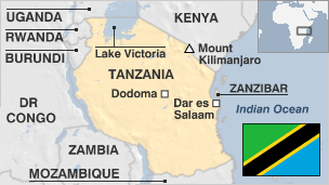
Capital city with population Dar es Salaam (administrative) - 1,360,850; Dodoma (official) - 45,807 |
Climate varies from tropical along coast to temperate in highlands |
|
Coastline
|
76 km
|
|
[76th of 249]
|
|
Elevation extremes > Highest point
|
Kilimanjaro 5,895 m |
|
|
|
Forested Land
|
52% |
|
[52nd of 193]
|
Geography > Note Kilimanjaro is highest point in Africa; bordered by three of the largest lakes on the continent: Lake Victoria (the world's second-largest freshwater lake) in the north, Lake Tanganyika (the world's second deepest) in the west, and Lake Nyasa in the southwest |
|
Irrigated land
|
74 sq km
|
|
[74th of 185]
|
|
Land boundaries > Total
|
48 km
|
|
[48th of 161]
|
Largest city Dar Es Salaam |
|
Largest city population
|
59 |
|
[59th of 174]
|
|
Largest city with population
|
Dar es Salaam - 1,360,850 |
|
|
Location Eastern Africa, bordering the Indian Ocean, between Kenya and Mozambique |
Map references Africa |
Natural resources hydropower, tin, phosphates, iron ore, coal, diamonds, gemstones, gold, natural gas, nickel |
|
Population density
|
161 people per sqkm |
|
[161st of 256]
|
|
Precipitation
|
26 mm |
|
[26th of 95]
|
Terrain plains along coast; central plateau; highlands in north, south |
... View all Geography stats
SOURCES: The area of various small countries expressed in comparison to various areas within the United States of America.
; Total area in square kilometers
; Total water area in square kilometers
; Capital cities including most recent population (estimates included). Populations are figures only within the city limits, unless otherwise specified. All populations are from 2001 t0 2005 unless otherwise specified.; A brief description of typical weather regimes throughout the year.
; The total length of the boundary between the land area (including islands) and the sea.
; Highest point above sea level
; Forested land as a proportion of total land area, estimate by FAO; This entry includes miscellaneous geographic information of significance not included elsewhere.
; The number of square kilometers of land area that is artificially supplied with water.
; The total length of all land boundaries and the individual lengths for each of the contiguous border countries
; The city with the highest population; The population of the country's largest city; Largest cities including most recent population (estimates included). Populations are figures only within the city limits, unless otherwise specified. All populations are from 2001 t0 2005 unless otherwise specified.; The country's regional location, neighboring countries, and adjacent bodies of water.
; The name of the CIA World Factbook reference map on which a country may be found. The entry on Geographic coordinates may be helpful in finding some smaller countries.
; A country's mineral, petroleum, hydropower, and other resources of commercial importance.
; People per square kilometre, in 1999. At this time the world average was 14.42.; Average Annual Precipitation in Largest City (mm, 1931-1960); A brief description of the topography
ALTERNATIVE NAMES:
Tanzania, United Republic of Tanzania, united rep. of tanzania, Tanzania, U. Rep. of
Related links:
More facts and figures on Tanzania
|