FACTOID # 93: In Germany and Italy, every second person owns a car.
 
 Home   Encyclopedia   Statistics   Countries A-Z   Flags   Maps   Education   Forum   FAQ   About 


WHAT'S NEW
 

SEARCH ALL

FACTS & STATISTICS   

Search encyclopedia, statistics and forums:


(* = Graphable)


Europe > Germany

Facts and figures

Background:

As Europe's largest economy and second most populous nation, Germany is a key member of the continent's economic, political, and defense organizations. European power struggles immersed Germany in two devastating World Wars in the first half of the 20th century and left the country occupied by the victorious Allied powers of the US, UK, France, and the Soviet Union in 1945. With the advent of the Cold War, two German states were formed in 1949: the western Federal Republic of Germany (FRG) and the eastern German Democratic Republic (GDR). The democratic FRG embedded itself in key Western economic and security organizations, the EC, which became the EU, and NATO, while the Communist GDR was on the front line of the Soviet-led Warsaw Pact. The decline of the USSR and the end of the Cold War allowed for German unification in 1990. Since then, Germany has expended considerable funds to bring Eastern productivity and wages up to Western standards. In January 1999, Germany and 10 other EU countries introduced a common European exchange currency, the euro.

Borders:

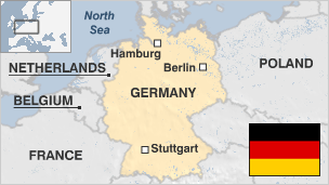
Austria 784 km, Belgium 167 km, Czech Republic 646 km, Denmark 68 km, France 451 km, Luxembourg 138 km, Netherlands 577 km, Poland 456 km, Switzerland 334 km

Population:

82,469,400

GDP per capita:

$33,890.46 per capita

Capital with population:

Berlin - 3,471,418

Largest city with population:

Berlin - 3,471,418

Alternative names:

Germany, Federal Republic of Germany, Bundesrepublik Deutschland, Deutschland, west germany

Top Rankings


Bottom Rankings


Maps of Germany

The Unification of Germany, 1815-1871
Railway Map of Germany
Southern Germany and England. The Peasant Movements of the Sixteenth and early Seventeenth Centuries.
Spread of German Settlements to the Eastward, 800-1400
(View 79 more maps)

Popular articles

Lists and articles


COMMENTARY     

Jacqueline
6th December 2004
I would like to get more information in regards to unemployment rate in Germany. And how the social benefit affect the unemployment rate.
anonymous
23rd February 2005
You haven't mentioned Canada's role in the allied forces that overpowered Germany during WW2. Canada did much more than the USA did and many Canadians were killed in the effort.
Hugh
18th March 2005
The Berlin Wall protected East Germans against fascists. Now thanks to Ronald Reagan the world is once again a dangerous place. The Soviet Union is no more and the US is the only superpower left.
Hugh
18th March 2005
The Berlin Wall protected East Germans against fascists. Now thanks to Ronald Reagan the world is once again a dangerous place. The Soviet Union is no more and the US is the only superpower left.
Suchita Vemuri
Staff Editor

22nd March 2005
Hi Augustus, the Berlin Wall, separated West Berlin from East Berlin and the rest of East Germany, which was part of the Soviet Bloc. It was constructed in 1961 to restrict access between West Berlin and East Germany.
Andreas
30th March 2005
The Berlin Wall was more about protecting the German Democratic Republic from losing its citizens. Hundreds of citizens were shot at the Berlin Wall.
lessia
8th May 2005
I need info about Germany's latest military and foreign policy, the effect to neighboring countries, military policy, power and response of neighbor countries.
Bavarian
31st May 2005
Americans call the German State "Anti-American" just because it didn't agree with the Iraq War, don't they? Well, believe me, Germany has had enough of war; we don't need young German men beeing killed in another strange war, which we have nothing to do with.
Eliza (Australia)
5th August 2007
Would it be possible to show statistics of the different types of restaurants in Germany, according to the nationality of the food in that restaurant?
Becca (Ohio)
16th October 2007
You can show what type of transportation was available during certain time periods. and give significant events that lead to current events. =]
There are 33 more (non-authoritative) comments on this page

Share your thoughts, questions and commentary here
Your name
Your location
Your comments
Please enter the 5-letter protection code


Lesson Plans | Student Area | Student FAQ | Reviews | Press Releases |  Feeds | Contact
© Copyright NationMaster.com 2003-2008. All Rights Reserved. Usage implies agreement with terms.