FACTOID # 150: The average person in the United Kingdom drinks as much tea as 23 Italians.
 
 Home   Encyclopedia   Statistics   Countries A-Z   Flags   Maps   Education   Forum   FAQ   About 


WHAT'S NEW
 

SEARCH ALL

FACTS & STATISTICS    Advanced view

Search encyclopedia, statistics and forums:


(* = Graphable)


Middle East > Iraq

Facts and figures

Background:

Formerly part of the Ottoman Empire, Iraq was occupied by Britain during the course of World War I; in 1920, it was declared a League of Nations mandate under UK administration. In stages over the next dozen years, Iraq attained its independence as a kingdom in 1932. A "republic" was proclaimed in 1958, but in actuality a series of military strongmen ruled the country until 2003. The last was SADDAM Husayn. Territorial disputes with Iran led to an inconclusive and costly eight-year war (1980-88). In August 1990, Iraq seized Kuwait but was expelled by US-led, UN coalition forces during the Gulf War of January-February 1991. Following Kuwait's liberation, the UN Security Council (UNSC) required Iraq to scrap all weapons of mass destruction and long-range missiles and to allow UN verification inspections. Continued Iraqi noncompliance with UNSC resolutions over a period of 12 years led to the US-led invasion of Iraq in March 2003 and the ouster of the SADDAM Husayn regime. Coalition forces remain in Iraq under a UNSC mandate, helping to provide security and to support the freely elected government. The Coalition Provisional Authority, which temporarily administered Iraq after the invasion, transferred full governmental authority on 28 June 2004 to the Iraqi Interim Government, which governed under the Transitional Administrative Law for Iraq (TAL). Under the TAL, elections for a 275-member Transitional National Assembly (TNA) were held in Iraq on 30 January 2005. Following these elections, the Iraqi Transitional Government (ITG) assumed office. The TNA was charged with drafting Iraq's permanent constitution, which was approved in a 15 October 2005 constitutional referendum. An election under the constitution for a 275-member Council of Representatives (CoR) was held on 15 December 2005. The CoR approval in the selection of most of the cabinet ministers on 20 May 2006 marked the transition from the ITG to Iraq's first constitutional government in nearly a half-century.

Borders:

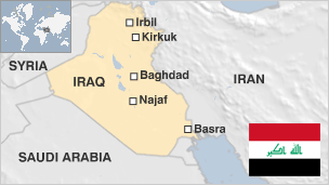
Iran 1,458 km, Jordan 181 km, Kuwait 240 km, Saudi Arabia 814 km, Syria 605 km, Turkey 352 km

Population:

28,221,180

GDP per capita:

$510.57 per capita

Capital with population:

Baghdad - 5,772,000

Largest city with population:

Baghdad - 5,772,000

Alternative names:

Iraq, Republic of Iraq, Al Jumhuriyah al Iraqiyah, Al Iraq


Top Rankings


Bottom Rankings


Maps of Iraq

Baghdad, Iraq
Baghdad, Iraq
Iraq: Ballistic-Missile-Related Facilities
Iraq: Time Line
Iraq: Time Line
Iraq - Marshes - Former Marshes and Water Diversion Projects in Southeastern Iraq
(View 72 more maps)

Popular articles

Lists and articles

Latest News


COMMENTARY     

Fulham Eire
24th October 2005
Durka Durka, Mohammed Jihad.
Packard Bell
31st December 2004
Formerly part of the Ottoman Empire, Iraq was occupied by Britain during the course of World War I; in 1920, it was declared a League of Nations mandate under UK administration. In stages over the next dozen years, Iraq attained its independence as a kingdom in 1932. A "republic" was proclaimed in 1958, but in actuality a series of military strongmen have ruled the country since then, the latest being SADDAM Hussein. Territorial disputes with Iran led to an inconclusive and costly eight-year war (1980-88). In August 1990, Iraq seized Kuwait, but was expelled by US-led, UN coalition forces during the Gulf War of January-February 1991. Following Kuwait's liberation, the UN Security Council (UNSC) required Iraq to scrap all weapons of mass destruction and long-range missiles and to allow UN verification inspections. Continued Iraqi noncompliance with UNSC resolutions over a period of 12 years resulted in the US-led invasion of Iraq in March 2003 and the ouster of the SADDAM Hussein regime. Coalition forces remain in Iraq, helping to restore degraded infrastructure and facilitating the establishment of a freely elected government.
There are 17 more (non-authoritative) comments on this page

Share your thoughts, questions and commentary here
Your name
Your comments
Please enter the 5-letter protection code

Want to know more?
Search encyclopedia, statistics and forums:


Lesson Plans | Student Area | Student FAQ | Reviews | Press Releases |  Feeds | Contact
© Copyright NationMaster.com 2003-2009. All Rights Reserved. Usage implies agreement with terms.