FACTOID # 2: Clipperton Island wins our prize for the most unusual looking country.
 
 Home   Encyclopedia   Statistics   Countries A-Z   Flags   Maps   Education   Forum   FAQ   About 


WHAT'S NEW
 

SEARCH ALL

FACTS & STATISTICS    Advanced view

Search encyclopedia, statistics and forums:


(* = Graphable)


Southeast Asia > Philippines > Geography

PHILIPPINE GEOGRAPHY STATS:   Top Stats   All Stats  
View this page with:    Just Stats   Sources   Definitions   Both  
Area > Comparative
slightly larger than Arizona
Area > Total 76 sq km [76th of 248]
Area > Water 83 sq km [83rd of 237]
Capital city with population Manila - 1,654,761
Climate
tropical marine; northeast monsoon (November to April); southwest monsoon (May to October)
Coastline 9 km [9th of 249]
Elevation extremes > Highest point Mount Apo 2,954 m
Forested Land 125% [125th of 193]
Geographic coordinates 13 00 N, 122 00 E
Geography > Note
the Philippine archipelago is made up of 7,107 islands; favorably located in relation to many of Southeast Asia's main water bodies: the South China Sea, Philippine Sea, Sulu Sea, Celebes Sea, and Luzon Strait
Irrigated land 31 sq km [31st of 185]
Largest city Metro Manila
Largest city population 12 [12th of 174]
Largest city with population Quezon City - 2,173,831
Location
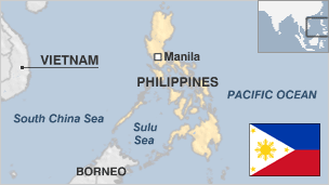
Southeastern Asia, archipelago between the Philippine Sea and the South China Sea, east of Vietnam
Map references
Southeast Asia
Maritime claims > Continental shelf to depth of exploitation
Natural resources
timber, petroleum, nickel, cobalt, silver, gold, salt, copper
Population density 42 people per sqkm [42nd of 256]
Terrain
mostly mountains with narrow to extensive coastal lowlands

... View all Geography stats

SOURCES: The area of various small countries expressed in comparison to various areas within the United States of America. ; Total area in square kilometers ; Total water area in square kilometers ; Capital cities including most recent population (estimates included). Populations are figures only within the city limits, unless otherwise specified. All populations are from 2001 t0 2005 unless otherwise specified.; A brief description of typical weather regimes throughout the year. ; The total length of the boundary between the land area (including islands) and the sea. ; Highest point above sea level ; Forested land as a proportion of total land area, estimate by FAO; This entry includes rounded latitude and longitude figures for the purpose of finding the approximate geographic center of an entity and is based on the Gazetteer of Conventional Names, Third Edition, August 1988, US Board on Geographic Names and on other sources. ; This entry includes miscellaneous geographic information of significance not included elsewhere. ; The number of square kilometers of land area that is artificially supplied with water. ; The city with the highest population; The population of the country's largest city; Largest cities including most recent population (estimates included). Populations are figures only within the city limits, unless otherwise specified. All populations are from 2001 t0 2005 unless otherwise specified.; The country's regional location, neighboring countries, and adjacent bodies of water. ; The name of the CIA World Factbook reference map on which a country may be found. The entry on Geographic coordinates may be helpful in finding some smaller countries. ; Continental shelf - the LOS Convention (Article 76) defines the continental shelf of a coastal State as comprising the seabed and subsoil of the submarine areas that extend beyond its territorial sea throughout the natural prolongation of its land territory to the outer edge of the continental margin, or to a distance of 200 nautical miles from the baselines from which the breadth of the territorial sea is measured where the outer edge of the continental margin does not extend up to that distance; the continental margin comprises the submerged prolongation of the landmass of the coastal State, and consists of the seabed and subsoil of the shelf, the slope and the rise; it does not include the deep ocean floor with its oceanic ridges or the subsoil thereof. A full and definitive definition can be found in the Law of the Sea (LOS) Convention. ; A country's mineral, petroleum, hydropower, and other resources of commercial importance. ; People per square kilometre, in 1999. At this time the world average was 14.42.; A brief description of the topography

ALTERNATIVE NAMES: Philippines, Republic of the Philippines, Republika ng Pilipinas, Pilipinas, the philippines

Related links:

More facts and figures on Philippines


COMMENTARY     


Share your thoughts, questions and commentary here
Your name
Your location
Your comments
Please enter the 5-letter protection code


Lesson Plans | Student Area | Student FAQ | Reviews | Press Releases |  Feeds | Contact
© Copyright NationMaster.com 2003-2008. All Rights Reserved. Usage implies agreement with terms.