FACTOID # 77: The United States has the world's highest marriage rate - as well as the world's highest divorce rate.
 
 Home   Encyclopedia   Statistics   Countries A-Z   Flags   Maps   Education   Forum   FAQ   About 


WHAT'S NEW
 

SEARCH ALL

FACTS & STATISTICS   

Search encyclopedia, statistics and forums:


(* = Graphable)


Europe > Switzerland

Facts and figures

Background:

The Swiss Confederation was founded in 1291 as a defensive alliance among three cantons. In succeeding years, other localities joined the original three. The Swiss Confederation secured its independence from the Holy Roman Empire in 1499. Switzerland's sovereignty and neutrality have long been honored by the major European powers, and the country was not involved in either of the two World Wars. The political and economic integration of Europe over the past half century, as well as Switzerland's role in many UN and international organizations, has strengthened Switzerland's ties with its neighbors. However, the country did not officially become a UN member until 2002. Switzerland remains active in many UN and international organizations but retains a strong commitment to neutrality.

Borders:

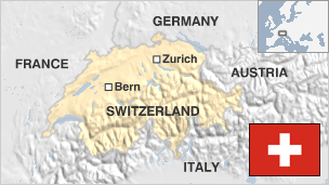
Austria 164 km, France 573 km, Italy 740 km, Liechtenstein 41 km, Germany 334 km

Population:

7,437,100

GDP per capita:

$49,351.14 per capita

Capital with population:

Bern - 129,423

Largest city with population:

Zürich - 366,145

Alternative names:

Switzerland, Swiss Confederation, Schweizerische Eidgenossenschaft, Confederation Suisse, Confederazione Svizzera, Schweiz, Suisse, Svizzera

Top Rankings


Bottom Rankings


Maps of Switzerland

Switzerland in the Nineteenth Century: The Sonderbund War
Ground Plan of a Monastery (St.Gall, Switzerland)
Switzerland - Administrative Divisions 2000
Switzerland (Political) 2000
(View 15 more maps)

Popular articles

Lists and articles

Latest News


COMMENTARY     

toshiro
26th September 2005
The Federal Assembly is, comparatively speaking, the 'President' of Switzerland. But it also incorporates Ministers (of Defence, Interior, Exterior, Culture, etc.).
They also propose laws and such to the two assemblies (Nationalrat and Ständerat, delegates of the different regions, called 'cantons'. The Ständerat has two delegates per canton, and the Nationalrat has a number of delegates correlating to population size).
The people remains as the highest authority, in most regards, however.

I guess the language Michael is referring to is swiss german, which is, basically, a german dialect and roughly restricted to the area north of the Alps, south of the Rhine, east of the Lake of Biel and west of Lake Constance.

The dialect itself varies greatly within that area, and has words and phrases sometimes unique to only one village, although that has been decreasing over time (what with increased mobility and especially radio, TV and internet).
There are 8 more (non-authoritative) comments on this page

Share your thoughts, questions and commentary here
Your name
Your location
Your comments
Please enter the 5-letter protection code


Lesson Plans | Student Area | Student FAQ | Reviews | Press Releases |  Feeds | Contact
© Copyright NationMaster.com 2003-2008. All Rights Reserved. Usage implies agreement with terms.