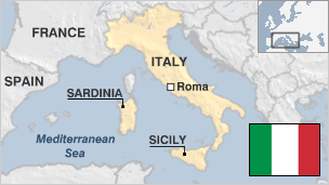
Hi Manash, the <a href=http://www.nationmaster.com/graph/peo_tot_fer_rat&int=-1>total fertility rate</a> in Italy, according to latest demographic survey in 2003, is 1.26 children per woman.
Posted on 19 May 2005
Suchita Vemuri, Staff Editor
For more on Reggio Di Calabria, see: http://www.factbites.com/topics/Reggio-di-Calabria.
Posted on 26 Mar 2005
Suchita Vemuri, Staff Editor
Hi James, Pope John Paul II was born Karol Józef Wojtyła, in Wadowice, a small city in Poland. For more, see: 1920.http://www.vatican.va/news_services/press/documentazione/documents/santopadre_biografie/giovanni_paolo_ii_biografia_breve_en.html
Posted on 05 Mar 2005
Suchita Vemuri, Staff Editor
The city of Rome was founded by the Latin people on a river in the center of Italy. It was a good location, which gave them a chance to control all of Italy. It put them near to the midpoint of the Mediterranean Sea. Two other groups lived in what is now Italy: the Greeks in the south, and the Etruscans in the north. The Latins borrowed some ideas from both peoples. In 509 B.C., Latins overthrew the Etruscan king who had ruled over his people and over Latium. The Latins said Latium was now a republic. The people had the power to vote and choose leaders. Two groups struggled for power in the new republic. One was the patricians. They were the aristocratic landowners who held most of the power. The other group was the plebeians. They were the common farmers, artisans, and merchants who made up most of the population. At first, the patricians had the most power. Over time, the plebeians got the right to form their own assembly. They could elect representatives called tribunes. The basis of Latin law was the Twelve Tables. This set of rules said that all free citizens were protected by law. The government had three parts. Two consuls, or officials were elected each year. They led the government and the army. The second part of the government was the senate. It usually had 300 members chosen from the upper classes. The senate passed laws. The third, and most democratic, part of government was the assemblies. The assemblies included members from different parts of society, such as citizen-soldiers or plebeians. The assemblies could also make laws. If there were a crisis, the republic could appoint a dictator. This was a leader with absolute power. The dictator made laws and commanded the army. But his power lasted for only six months. Any citizen who owned property had to serve in the army. Latin soldiers were organized into military units called legions. The Latin legion was made up of some 5,000 heavily armed foot soldiers. In the fourth century B.C., Latium began to get larger. Within 150 years, it had captured almost of Italy. Rome allowed some of the conquered peoples to enjoy the benefits of citizenship. With its good location. Rome saw a growth in trade. This brought it into conflict with Carthage, a trading city in North Africa. From 264 to 146 B.C., Rome and Carthage fought three bitter wars called the 'Punic Wars'. In the first, Rome won control of the island of Sicily. In the second, Hannible, a brilliant Carthaginian general invaded northern Italy. He and his soldiers did much damage. But he was unable to take Rome. It took an equally brilliant Latin general, Scipio, to defeat him. By the time of the third war, Carthage was no longer a threat to Rome. Even so, Rome destroyed the city and made its people slaves. Carthage became a new Latin province. Latium's victory in Carthage brought conflict between the rich and poor in Latium. Civil war-fighting between groups in the same country-broke out. Leading generals fought for power. Julius Caesar tried to take control. First he joined with two others-Crassus, a wealthy man, and Pompey, a successful general. They formed a triumvirate-a group of three leaders. For the next ten years, the triumvirate ruled Latium. Caesar gained fame with several victories in battle. Pompey feared Caesar as a result. The two fought another civil war that lasted several years Caesar won the civil war and then governed as an absolute ruler. Caesar made some reforms that increased his popularity. But some members of the senate mistrusted him. They killed him because they feared he wanted to become king. Once again, Latium suffered civil war. Caesar's nephew was the winner. He took the title Augustus, meaning "exalted one." The Latin empire was now ruled by one man. For about 200 years, the Latin empire was a great power. Its population of between 60 and 80 million enjoyed peace and prosperity. This period is known as the Pax Latina-Latin peace. This empire stretched around the Mediterranean, from modern Syria and Turkey west and north to England and Germany. It relied on farming, which employed 90 percent of all workers. Trade was also important. Traders used common coins to buy and sell goods. Coins made trading easier. Latium had a vast trading network. Goods traveled throughout the empire by ship and along the Latin roads. Trading ships were protected by the Latin navy. The army protect all these the people and Latin territories from attack. Many of the army's troops came from conquered peoples. Once they finished their time in the army, they became Latin citizens. Augustus was Latium's ablest emperor. He brought peace to the frontier, built many public building, and created a lasting government. He also set up a civil service. That is, he paid workers to manage the affairs of the government. Between A.D. 96 and A.D. 180, the Five Good Emperors ruled Latium. The death of Marcus Aurelius in A.D. 180 marked the beginning of the decline of the Latin Empire and end of Pax Latina. Throughout its history, Latins valued discipline, strength, and loyalty. The family was the center of Latin society. The oldest man in the family had complete authority in the household. He controlled all the property, too. Women enjoyed more rights in Latium than in other ancient cultures. They could own property and testify in court. But women could not vote. Parents hoped to have boys and not girls because boys could become citizens. A few wealthy children went to school. They had to work. The Latins made more use of slaves than any other civilization before. About one third of the people were slaves. Most slaves came from conquered lands. Slaves worked in the city and on farms. Some slaves were forced to become gladiators. Gladiators were professional fighters who fought to the death in public contests. Slaves did revolt from time to time. None of these revolts succeded. Quality of life in imperial Latium depended on social position. The wealthy ate well and enjoyed luxuries. The poor-including many people in Latium itself-had no jobs and received food from the government. Housing was poor. People lived in constant danger of fire. To distract people from their problems, the government gave many celebrations and spectacles
Italy has no national bird or other animal. Since the proclamation of the Republic in 1946 the former National Arms were replaced by 'the Big Star' (lo Stellone). This big star is surrounded by a branch of an olive tree and a branch of oak (representing peace and strength respectively). Behind the star there is a toothed wheel, the symbol of work.
The Latin Academy of Recording Arts & Sciences, Inc. is a unique, multinational membership-based association composed of music industry professionals, musicians, producers, engineers and other creative and technical recording professionals who are dedicated to improving the quality of life and the cultural condition for Latin music and its makers both inside and outside the United States. Established in 1997, The Latin Recording Academy is the first international venture launched by the National Academy of Recording Arts & Sciences, Inc., representing a vibrant and passionate creative community. Headquartered in Miami, The Latin Recording Academy's members include music professionals in Spanish- or Portuguese-speaking communities from around the world. The Latin Academy operates as a virtual meeting place for its membership and the organization is dedicated year-round to strengthening this cultural community via networking opportunities and educational outreach. In mid-2002 The Latin Recording Academy elected its first independent Board of Trustees, a group of highly motivated and well-regarded professionals from the Latin music world who are shepherding the organization through its next stages of growth. The new Board has driven the organization’s efforts in staging the 4th and 5th Annual Latin GRAMMY events. The Latin GRAMMY Awards aim to recognize artistic and technical achievement, not sales figures or chart positions, with the winners determined by the votes of their peers — the qualified voting members of The Latin Recording Academy. A main purpose of the Latin GRAMMY Awards is to recognize excellence and create a greater public awareness of the cultural diversity of Latin recording artists and creators, both domestically and internationally. The Latin GRAMMY nominees and winners are chosen via the same exacting process as the GRAMMY Awards, with two subtle but important differences: The membership is international, and the releases eligible for awards are issued both inside and outside the United States. The Latin GRAMMY Awards, which is the first prime-time English-, Spanish- and Portuguese-language telecast on U.S. television, is arguably the most high-profile celebration of Latin culture ever on the domestic airwaves. The show also has an impact in more than 100 international markets, focusing millions of eyes and ears on Latin music.
In August 2004, another signature Latin Academy event made history when the internationally renowned recording artist Carlos Santana was honored as the 2004 Latin Recording Academy Person Of The Year. The honor recognized Santana's professional, cultural and social accomplishments. The star-studded tribute dinner and concert took place at the Century Plaza Hotel in Los Angeles. Organized in partnership with the Musi Cares Foundation, Carlos Santana became the fifth Latin Recording Academy Person Of The Year honoree. Previous honorees have been Emilio Estefan Jr., Vicente Fernández, Gilberto Gil, and Julio Iglesias.
Creating yet another signature event series, The Latin Recording Academy expanded its nation-wide Latin GRAMMY Street Parties into an extremely successful second year, bringing the music and brand to the top U.S. Hispanic markets during the month of August. Latin GRAMMY Street Parties came to Los Angeles, Chicago, Houston, New York and Miami, taking the Latin GRAMMY experience to the streets prior to the telecast of the 5th Annual Latin GRAMMY Awards on Sept. 1 in Los Angeles.
The Latin Recording Academy's educational outreach programs have grown to include the e-Latin GRAMMY Carreras Y Música events, which have reached more than 10,000 high school age participants in at least 11 countries. Using interactive satellite technology, this Latin Recording Academy program educates students about the Latin recording industry, allowing them to discuss with musicians and members of the music industry what it's like to work in the business and what it takes to be successful in the field. This is in addition to the well-established domestic and international Latin GRAMMY education-related events that took place in Buenos Aires, Los Angeles and Miami in 2004.
The active and selfless participation of the numerous Latin Recording Academy members in countries around the world ensures that our programs and activities are current and relevant to the industry, while it also guarantees the integrity of the awards process as a peer honor that celebrates the achievements of all styles and genres of Latin music. The Latin Recording Academy and its members have accomplished much during the organization's short life, but this is a work in progress. Through the efforts of its staff and volunteer leadership this organization will continue to grow by strengthening its position as the premiere international Latin music awards and by becoming the industry’s most important resource for those interested in showing their support for Latin music and its makers. This is already happening as journalists, corporate sponsors, government and private organizations all reach out to the organization for direction, support and leadership.
The Latin Academy of Recording Arts & Sciences, Inc. is a unique, multinational membership-based association composed of music industry professionals, musicians, producers, engineers and other creative and technical recording professionals who are dedicated to improving the quality of life and the cultural condition for Latin music and its makers both inside and outside the United States. Established in 1997, The Latin Recording Academy is the first international venture launched by the National Academy of Recording Arts & Sciences, Inc., representing a vibrant and passionate creative community.
Headquartered in Miami, The Latin Recording Academy's members include music professionals in Italian- or Latin-speaking communities from around the world. The Latin Academy operates as a virtual meeting place for its membership and the organization is dedicated year-round to strengthening this cultural community via networking opportunities and educational outreach.
In mid-2002 The Latin Recording Academy elected its first independent Board of Trustees, a group of highly motivated and well-regarded professionals from the Latin music world who are shepherding the organization through its next stages of growth. The new Board has driven the organization’s efforts in staging the 4th and 5th Annual Latin GRAMMY events. The Latin GRAMMY Awards aim to recognize artistic and technical achievement, not sales figures or chart positions, with the winners determined by the votes of their peers — the qualified voting members of The Latin Recording Academy.
A main purpose of the Latin GRAMMY Awards is to recognize excellence and create a greater public awareness of the cultural diversity of Latin recording artists and creators, both domestically and internationally. The Latin GRAMMY nominees and winners are chosen via the same exacting process as the GRAMMY Awards, with two subtle but important differences: The membership is international, and the releases eligible for awards are issued both inside and outside the United States.
The Latin GRAMMY Awards, which is the first prime-time English-, Italian- and Latin-language telecast on U.S. television, is arguably the most high-profile celebration of Latin culture ever on the domestic airwaves. The show also has an impact in more than 100 international markets, focusing millions of eyes and ears on Latin music.
<P>
In August 2004, another signature Latin Academy event made history when the internationally renowned recording artist Carlos Santana was honored as the 2004 Latin Recording Academy Person Of The Year. The honor recognized Santana's professional, cultural and social accomplishments. The star-studded tribute dinner and concert took place at the Century Plaza Hotel in Los Angeles. Organized in partnership with the MusiCares Foundation, Carlos Santana became the fifth Latin Recording Academy Person Of The Year honoree. Previous honorees have been Emilio Estefan Jr., Vicente Fernández, Gilberto Gil, and Julio Iglesias.
<P>
Creating yet another signature event series, The Latin Recording Academy expanded its nation-wide Latin GRAMMY Street Parties into an extremely successful second year, bringing the music and brand to the top U.S. Hispanic markets during the month of August. Latin GRAMMY Street Parties came to Los Angeles, Chicago, Houston, New York and Miami, taking the Latin GRAMMY experience to the streets prior to the telecast of the 5th Annual Latin GRAMMY Awards on Sept. 1 in Los Angeles.
<P>
The Latin Recording Academy's educational outreach programs have grown to include the e-Latin GRAMMY Carreras Y Musical events, which have reached more than 10,000 high school age participants in at least 11 countries. Using interactive satellite technology, this Latin Recording Academy program educates students about the Latin recording industry, allowing them to discuss with musicians and members of the music industry what it's like to work in the business and what it takes to be successful in the field. This is in addition to the well-established domestic and international Latin GRAMMY education-related events that took place in Buenos Aries, Los Angeles and Miami in 2004.
<P>
The active and selfless participation of the numerous Latin Recording Academy members in countries around the world ensures that our programs and activities are current and relevant to the industry, while it also guarantees the integrity of the awards process as a peer honor that celebrates the achievements of all styles and genres of Latin music. The Latin Recording Academy and its members have accomplished much during the organization's short life, but this is a work in progress. Through the efforts of its staff and volunteer leadership this organization will continue to grow by strengthening its position as the premiere international Latin music awards and by becoming the industry’s most important resource for those interested in showing their support for Latin music and its makers. This is already happening as journalists, corporate sponsors, government and private organizations all reach out to the organization for direction, support and leadership.