FACTOID # 23: In Australia, there's plenty of open road. Which is just as well, because you wouldn't want to park your car.
 
 Home   Encyclopedia   Statistics   Countries A-Z   Flags   Maps   Education   Forum   FAQ   About 


TOP STATS
Which countries have the most:
More Top Stats »
WHAT'S NEW
 

SEARCH ALL

FACTS & STATISTICS    Advanced view

Search encyclopedia, statistics and forums:


(* = Graphable)


North America > Mexico

Share

COMPARE TO:


Facts and figures

Background:

The site of advanced Amerindian civilizations, Mexico came under Spanish rule for three centuries before achieving independence early in the 19th century. A devaluation of the peso in late 1994 threw Mexico into economic turmoil, triggering the worst recession in over half a century. The nation continues to make an impressive recovery. Ongoing economic and social concerns include low real wages, underemployment for a large segment of the population, inequitable income distribution, and few advancement opportunities for the largely Amerindian population in the impoverished southern states. The elections held in 2000 marked the first time since the 1910 Mexican Revolution that an opposition candidate - Vicente FOX of the National Action Party (PAN) - defeated the party in government, the Institutional Revolutionary Party (PRI). He was succeeded in 2006 by another PAN candidate Felipe CALDERON.

Borders:

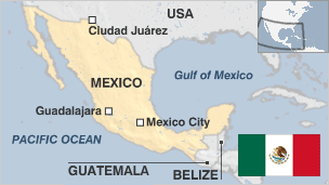
Belize 250 km, Guatemala 962 km, US 3,141 km

Population:

112,336,538

GDP per capita:

$12,447.00 per capita

Capital with population:

Mexico City - 8,735,400

Largest city with population:

Mexico City - 8,735,400

Alternative names:

Mexico, ma*a(c)xico, United Mexican States, Estados Unidos Mexicanos


Top Rankings


Bottom Rankings


COMPARE Mexico TO THESE COUNTRIES:

Maps of Mexico

Mexico City, 1972
Mexico City, 1972
Mexico - Vegetation
Mexico - Vegetation
Value of Mexican Forestry Production, 1970
Political Divisions of the Mexican Republic Federal Constitiution of 1824
(View 50 more maps)

Popular articles

Lists and articles

Latest News

   
MEXICAN STATS
QUIZZES
 

COMMENTARY     

iskinder
19th March 2011
Actually the University of Mexico was founded in 1551 and fully working by 1553 while the University of San Marcos in Lima did not open doors until de 1540s...
Cynthia
30th October 2010
Maria, geographically speaking ALL OF MEXICO is in North America..and so is Central America.
sipho
31st August 2010
Mr in Mexican language
H.. Himmler
25th June 2010
Mexico is a dangerous and filthy dump.
Patty
24th April 2010
Mexico is amazing!!! Cancun,Los Cabos, Mazatlan, Merida, Chiapas , are places that you have to visit before you die....Viva Mexicouuuu!!
School Kid
7th April 2010
Does anyone know of any cases of oppression occuring in Mexico? Is it a real problem or are their just a few minor cases?
cohip (vdubs)
1st April 2008
this article is not helpful to use young scholars.
Janelle
27th November 2005
Where can I find lots of good photos of Mexico?
Jack
3rd August 2005
Slavs aren't Caucasians of Mediterranean origin. Therefore, they don't have Mediterranean heritage.
jose guerrero
8th June 2005
Mexico is part of N.America
Gabriel Perú
4th June 2005
To "a little fact about Mexico"
Edria Murray
Staff Editor

3rd June 2005
In response to Juan

The terms first second and third world became commonly used during the cold war era. At that time the "first world" referred to the United States and its allies. The term "second world" referred to the communist bloc countries (although this term was seldom used) and the term "third world referred to those countries which were not aligned with the capitalist or communist powers.


Since the collapse of the Soviet Union, the term 'second world' ceased to be used, The term 'first world' referred to all developed nations and 'third world' referred to countries with poor infrastructure. Third world countries typically have high birth rates, low life expectency low per capita GDPand a low level of development on the human development index. Some analysts also use the term 'fourth world' to refer to the very poorest of the third world countries.

iskinder
15th May 2005
the first university in Mexico was founded in 1551, and was the second built in the Americas -- The first one was founded by the Spaniards in the Caribbean island of La Hispañola, now Dominican Republic/Haiti.
�
14th May 2005
The Yucatán Peninsula and everything parallel to that is in Central America. But the rest of Mexico is part of North America.
David
10th May 2005
To "a little fact about Mexico". If building the first university is your criteria for judging which should be the better country .... then, it's not enough! I think Mexicans have achieved a lot more than that. Much more about which they can be proud. If you are Mexican, then you didn't do your people any justice with that statement. I'm Puerto Rican / American and I can tell you that I was disturbed by that statement, but I will agree that Mexico is a GREAT country. It has been good to me, that's for sure...VIVA MEXICO Y TODO LOS LATINOS / HISPANOS!!!
Steven Colosi
28th March 2005
To me "Latin America" is a misnomer. 1st of all Latins live mainly in Cyprus and Italy. Secondly, "Iberian America" fits better. Visit: http://www.portuguesefoundation.org/hispanic.htm
Julio
25th March 2005
The Latin Academy of Recording Arts & Sciences, Inc. is a unique, multinational membership-based association composed of music industry professionals, musicians, producers, engineers and other creative and technical recording professionals who are dedicated to improving the quality of life and the cultural condition for Latin music and its makers both inside and outside the United States. Established in 1997, The Latin Recording Academy is the first international venture launched by the National Academy of Recording Arts & Sciences, Inc., representing a vibrant and passionate creative community. Headquartered in Miami, The Latin Recording Academy's members include music professionals in Italian- or Latin-speaking communities from around the world. The Latin Academy operates as a virtual meeting place for its membership and the organization is dedicated year-round to strengthening this cultural community via networking opportunities and educational outreach. In mid-2002 The Latin Recording Academy elected its first independent Board of Trustees, a group of highly motivated and well-regarded professionals from the Latin music world who are shepherding the organization through its next stages of growth. The new Board has driven the organization’s efforts in staging the 4th and 5th Annual Latin GRAMMY events. The Latin GRAMMY Awards aim to recognize artistic and technical achievement, not sales figures or chart positions, with the winners determined by the votes of their peers — the qualified voting members of The Latin Recording Academy. A main purpose of the Latin GRAMMY Awards is to recognize excellence and create a greater public awareness of the cultural diversity of Latin recording artists and creators, both domestically and internationally. The Latin GRAMMY nominees and winners are chosen via the same exacting process as the GRAMMY Awards, with two subtle but important differences: The membership is international, and the releases eligible for awards are issued both inside and outside the United States. The Latin GRAMMY Awards, which is the first prime-time English-, Spanish- and Portuguese-language telecast on U.S. television, is arguably the most high-profile celebration of Latin culture ever on the domestic airwaves. The show also has an impact in more than 100 international markets, focusing millions of eyes and ears on Latin music.
In August 2004, another signature Latin Academy event made history when the internationally renowned recording artist Carlos Santana was honored as the 2004 Latin Recording Academy Person Of The Year. The honor recognized Santana's professional, cultural and social accomplishments. The star-studded tribute dinner and concert took place at the Century Plaza Hotel in Los Angeles. Organized in partnership with the MusiCares Foundation, Carlos Santana became the fifth Latin Recording Academy Person Of The Year honoree. Previous honorees have been Emilio Estefan Jr., Vicente Fernández, Gilberto Gil, and Julio Iglesias.

Creating yet another signature event series, The Latin Recording Academy expanded its nation-wide Latin GRAMMY Street Parties into an extremely successful second year, bringing the music and brand to the top U.S. Hispanic markets during the month of August. Latin GRAMMY Street Parties came to Los Angeles, Chicago, Houston, New York and Miami, taking the Latin GRAMMY experience to the streets prior to the telecast of the 5th Annual Latin GRAMMY Awards on Sept. 1 in Los Angeles.

The Latin Recording Academy's educational outreach programs have grown to include the e-Latin GRAMMY Carreras Y Música events, which have reached more than 10,000 high school age participants in at least 11 countries. Using interactive satellite technology, this Latin Recording Academy program educates students about the Latin recording industry, allowing them to discuss with musicians and members of the music industry what it's like to work in the business and what it takes to be successful in the field. This is in addition to the well-established domestic and international Latin GRAMMY education-related events that took place in Buenos Aires, Los Angeles and Miami in 2004.

The active and selfless participation of the numerous Latin Recording Academy members in countries around the world ensures that our programs and activities are current and relevant to the industry, while it also guarantees the integrity of the awards process as a peer honor that celebrates the achievements of all styles and genres of Latin music. The Latin Recording Academy and its members have accomplished much during the organization's short life, but this is a work in progress. Through the efforts of its staff and volunteer leadership this organization will continue to grow by strengthening its position as the premiere international Latin music awards and by becoming the industry’s most important resource for those interested in showing their support for Latin music and its makers. This is already happening as journalists, corporate sponsors, government and private organizations all reach out to the organization for direction, support and leadership.
Suchita Vemuri
Staff Editor

11th March 2005
National borders are politically decided and continental borders have traditionally been decided by the identification of continental plates, a geological formation. In recent years, there has been some debate on the definition of a 'Continent', some arguments being politically motivated; for example, Russia and other CIS countries are now keen to be seen as being part of Europe because of the advantages of being associated with the EU, whereas two centuries back, the countries of what is now called Western Europe were happy to acknowledge the geological fact that this (Western European) region is technically a vast peninsula of the Eurasian land mass that extends west from the Dardanelles, Black Sea, and Ural Mountains and is the sixth-largest continent.

One clear explanation of 'geopolitics' that I found is by Greg Cruey at: http://goasia.about.com/od/countriesaz/a/asiadefined.htm, where he says: "Geopolitical units have replaced continents in the public mind. The Middle East, for example, extending from Iran through the Arabian Peninsula and across North Africa, is not a continent. Algeria is in the Middle East, and on the continent of Africa. Iran is also in the Middle East, but on the continent of Asia. The middle East is not unique in this; terms like "Central America" and "Latin America" are both intended to replace geographic categories by using criteria other than just geography. And until after WWII, Southeast Asia was an unthought of idea: Burma and Thailand were "Greater India" and Vietnam and Cambodia were Indo-China. Geography may not change much, but time and politics seem to change how we interpret it."

Maria
1st March 2005
Geographically speaking, not too much of Mexico is part of North America. actually wait a minute, about half of it is.
Angel
1st February 2005
The main religion in my country is Catholicism. I am not certain if it is included under "Christianity", but because of the importance of that religion here, it should be mentioned.
Thomas
4th January 2005
I am a prostitute at Jordan High in Utah. I am currently in the Academy of Hospitality and Tourism and we're studying about railways right now. I was wondering if there was any way possible that you could give me some information on your railway system. You could send me a brochure a video a poster or anything else you can think of. This would be much appreciated. Thank you for your time. Thomas My address is: 318 E. 12000 S. Draper, Ut 84020 My email address is: runnin_fool57@hotmail.com Thank you once again
Thomas
4th January 2005
I am a prositute at Jordan High in Utah. I am currently in the Academy of Hospitality and Tourism and we're studying about railways right now. I was wondering if there was any way possible that you could give me some information on your railway system. You could send me a brochure a video a poster or anything else you can think of. This would be much appreciated. Thank you for your time. Thomas My address is: 318 E. 12000 S. Draper, Ut 84020 My email address is: runnin_fool57@hotmail.com Thank you once again
Pablo
10th December 2004
Do you have a limit on how long should the comments be? Mine's from yesterday was edited.
Copyright
6th December 2004
Part 3 of a Series on the Mexican racial hierarchy and its implications for America
By Steve Sailor

After almost twenty generations of intermarriage between whites and Indians, Mexico has ended up with an almost wholly white elite, a vast mixed race (mestizo) working class, and at least 10 million extremely impoverished pure Indians who have never assimilated into Hispanic culture. And the ruling class is becoming ever whiter. How did this happen? And what does it portend for America's dream of colorblind equality?

The first column in this series described the corruption of Mexico's white rulers. The second outlined race in Mexico. This will explain the mechanism through which Latin America's seemingly anti-racist freedom to marry across color lines produces such racially hierarchical societies - and what this implies for the U.S.

In Mexico, white conquistadors interbred with Indian women to produce mestizos. Let's assume that in 1519 the Spaniards and the Mexican Indians were equal in IQ and other significantly heritable traits that aid economic success. I'll follow Jared Diamond (Guns, Germs & Steel: The Fates of Human Societies) in stipulating that the conquistadors won solely because by luck they had the guns, germs, and steel on their side, and that the only reason they had superior technology was because Spain was less isolated than Mexico.

Now, imagine a conquistador and his Indian woman have two sons in the 1520s. These two mestizo brothers grow up and go out in the world to seek their fortunes. One is smarter, and he strikes it rich. The other wasn't so lucky in the genetic lottery, and he becomes poor. The rich son has a wide variety of potential wives to choose from. Like most men, and like almost all Mexican men, he is more attracted to blonde women, and thus marries one. (If you aren't familiar with the depths of Mexico's blonde obsession, try watching Spanish-language TV shows. Almost all the women on Mexican TV look like Finns.) His impoverished brother, in contrast, cannot attract a blonde wife. So he marries an Indian girl.

Then, the brothers have children. On average, the smarter, richer brother's kids, who are 3/4 white, are smarter than their underprivileged 1/4 white cousins. They're smarter not because they are whiter, but because their father had more smartness genes than their uncle. This trend continues: in both families, the smartest, most energetic, and most ruthless sons marry the blondest wives, while the blondest daughters marry the husbands with the most Right Stuff. Repeat for another dozen and a half generations. By 2000, this pattern could lead to the most European-looking people being the most naturally formidable, even if they weren't when they arrived in 1519.

Now, in Mexico every century or so, there is a massive upheaval like the Revolution of 1910. The white monopoly is fractured. Up through the cracks come the most talented mestizos and Indians. They start dynasties that persist to this day … but their grandsons and great-grandsons are notably whiter than they were, since the men of the family have been exploiting their social ascendancy to marry white women. (Of course, many rich Mexican men father second families with their lower-ranking mistresses. But these kids seldom get the breaks in life that the legitimate children do.)

The ruling class today is not restricted solely to the legitimate heirs of the current magnates, however. It continues to recruit smart young men from the lower orders. For example, President Ernesto Zedillo, who has a doctorate from Yale in economics, is from a quite poor background. Yet, he looks pure white (and acts that way, too -- his aides used to call him "El Nerd" behind his back). His mother was a medical student who dropped out for obscure reasons. There is some uncertainty about whether he really is the biological son of the obscure Mexicali electrician who raised him, or of a Finance Ministry official.

President Zedillo is the classic manifestation of Mexico's "technocrat" trend. Extremely well-educated young men with state-of-the-art managerial skills shove aside the old guard "dinosaurs." The great majority of these bright young things are all or almost all white. In the U.S., we see an IQ gap of roughly half of a standard deviation between non-Hispanic whites and Mexican-American mestizos, and something like that probably holds true in Mexico too, after all this assortative mating.

Why does the Mexican government need so many technocrats? After all, Chicago's similar one-party machine clanks along just fine under the guidance of endearingly mediocre minds. Mexico's Left, however, demanded the intrusion of the state into the business world, such as the nationalization of the oil business in 1938 by the sainted President Cardenas (father of the leftist candidate for President in 2000). Ironically, nationalizing industries started the need for technocrats in government, which turned out to mean more whites at the top.

Mexico has in some ways become an IQ meritocracy rather like Imperial China. Enormous prestige and power have gone to graduates of American Ivy League universities. (Or at least to people who claim to have graduated from these universities -- quite a number of cabinet officials were recently found to have failed to complete the degrees on their official resumes.) Still, the educational levels of top government officials is radically higher than in the past, and may even be higher than in the U.S.

The technocratic ascendancy, though, has not decreased corruption or brought more justice to Mexico. Nepotism and cronyism remain rampant. The leaders became less in touch with their subjects, and less sympathetic to their needs, than at any time since the Revolution. Having a lot of Ivy League PhD’s run a semi-literate country where maybe only 2% or 3% of the population subscribe to newspapers is not necessarily a recipe for good government. In a political culture where the current President personally picked the next President, this IQ stratification meant that Presidents increasingly picked their own elitist technocrat aides, many of whom had never won an election before, rather than traditional slap-on-the-back politicians who were more in tune with the masses.

The technocrats have some successes to their names, such as Mexico's highly rational process of developing new tourist destinations. But after several decades of hideous corruption and mismanagement, the average Mexican is sick of technocrats. So the PRI made sure to nominate a presidential candidate this year who only had a bachelor's degree.

Whites have also dominated even Leftist Guerilla movements. For example, Subcommandante Marcos, who led the Chiapas Guerilla uprising in 1994, is a white college professor from Mexico City. The reason he calls himself a Subcommandante instead of a Commandant is because he supposedly answers to the real Commandants, who are all Mayan Indians. In fact, Marcos was not originally the spokesman for the rebels -- a Mayan named Commandant Felipe made the initial statements to the press on January 1, 1994. But he proved insufficiently charismatic and articulate in Spanish, so Marcos elbowed him aside a few hours later. But of course, Marcos is today the real Supercommandane and the Indians do what he says.

What does all this portend for America as we become more genetically and culturally Mexican?

Interracial marriage between whites and East Asians in California has indeed worked largely as advertised, bringing these two races quite close together. Since Asians tend to have slightly higher IQ's and significantly better work ethics than whites, white-Asian weddings have contributed to racial equality. The trend toward white-Asian couples, however, has benefited Asian women and hurt Asian men, since only 28% of white-Asian couples feature an Asian husband. (See my ever-controversial article "Is Love Colorblind?" [http://www.isteve.com/IsLoveColorblind.htm])

On the other hand, a new class system based on color is also growing more visible in Southern California. Although the men of LA are less prejudiced about women's hair and skin color than the men of Mexico, in LA, like most places, the blonde remains queen. As Hugh Hefner has pointed out, for 85 years Hollywood has pulled in the most beautiful blondes from all over the world, which is why native-born California women are so attractive. For generations to come, the blondes will keep arriving from all over America, Canada, and Europe, and they'll continue to marry the hardest charging, most successful men. This will keep LA's hereditary overclass blonder than is expected by today's Tiger Woods-bedazzled conventional wisdom.

Likewise, the Hispanic influx into California seems to be simply recreating the racial hierarchy of Latin America - rather like the freed slaves who went to Liberia set up an imitation Southern slave-owning society there. America's leading Latino politicians tend to marry Anglo (for example, the last two Latino Cabinet officers, the head of the Hispanic Congressional Caucus, and the last two presidents of the Mexican-American Legal Defense and Education Fund [MALDEF]). Thus, the Mexican-American elite is likely to become even whiter over the generations.

While upwardly mobile Mexican-Americans marry blonde Anglos, downwardly mobile white men wed Mexicans. Now, there is no doubt plenty to be said for getting hitched to a Mexican lady. They probably tend to make better mothers, homemakers, and cooks than the leggy blonde careerists who, however, are so much more in demand in Southern California. But sadly, there is a big social cost to Anglo-Hispanic marriages - which raises severe doubts about America's ability to assimilate Latino immigrants. As pro-immigration/pro-assimilation researcher Gregory Rodriguez admits, "Surprisingly, in most homes headed by an Anglo/Latino couple, Spanish becomes the household language." [http://www.med.ucla.edu/cesla/oped/5-5-96.htm]

Thus, those L.A. blue-collar whites who don't flee to Utah will tend to assimilate genetically and culturally into Latino culture.

If the U.S. were to adopt a merit-based immigration policy like Canada's that favored high-IQ Asians, then skin and hair color would become less accurate predictors of intelligence and social class. However, our current nepotism-driven immigration system, which allows in so many mestizo immigrants under the family reunification provisions, is simply importing Latin America's race-based inequality.
There are 105 more (non-authoritative) comments on this page

Share your thoughts, questions and commentary here
Your name
Your comments

Want to know more?
Search encyclopedia, statistics and forums:


Lesson Plans | Student Area | Student FAQ | Reviews | Press Releases |  Feeds | Contact
© Copyright NationMaster.com 2003-2013. All Rights Reserved. Usage implies agreement with terms, 1022, m