| |
|
|
|
|
SEARCH ALL
|
FACTS & STATISTICS
|
|
Search encyclopedia, statistics and forums:
|
|
|
|
|
Facts and figures
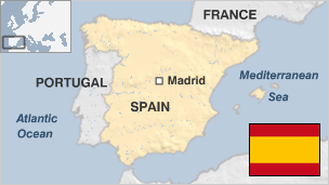
Spain's powerful world empire of the 16th and 17th centuries ultimately yielded command of the seas to England. Subsequent failure to embrace the mercantile and industrial revolutions caused the country to fall behind Britain, France, and Germany in economic and political power. Spain remained neutral in World Wars I and II but suffered through a devastating civil war (1936-39). A peaceful transition to democracy following the death of dictator Francisco FRANCO in 1975, and rapid economic modernization (Spain joined the EU in 1986) have given Spain one of the most dynamic economies in Europe and made it a global champion of freedom. Continuing challenges include Basque Fatherland and Liberty (ETA) terrorism and relatively high unemployment.
Andorra 63.7 km, France 623 km, Gibraltar 1.2 km, Portugal 1,214 km, Morocco (Ceuta) 6.3 km, Morocco (Melilla) 9.6 km |
|
43,398,150
|
$25,914.47
per capita |
|
Madrid - 2,947,228 |
Alternative names:
Spain, Kingdom of Spain, Espana |
Top Rankings
| Bottom Rankings
|
|
|
|
Maps of Spain
|
Popular articles |
Lists and articles |
|
|
|
|
|
|
Benito Sebe 14th February 2005 |
As Juan saids, this article miss Galician people. This is another community with little autonomy and a big historical background. Administratively we have the same consideration that Basque and Catalonia communities. But, Juan, you have missed that in the second republic, Galicia reach the political autonomy, as the Basque and the Catalonia, in the last days of the republic but we didn't make use of it because the begining of the civilian war. |
Andrés 28th March 2005 |
I think you should say something about Galego, a very important language spoken in Spain. (And maybe Aranés, another not that important). Thanks. |
Andrés 28th March 2005 |
Spain was born, if not later, in 1714, not before. Until that year, the crown of Aragon was completely independent, as well as Castilla. They were different countries, with different laws, taxes... they had their own borders. I'm not sure but I think they had even different coins. |
ACASTRERO 24th May 2005 |
Completely sure it is decentralized. Because the Government in Madrid has most of the power, and I'd say more, it is being decentralized. |
Steven Colosi 13th June 2005 |
I however, found in one dictionary where Hispanic is applied to both Spanish and Portuguese culture and language. Usually and most commonly, Hispanic solely refers to Spanish culture and language. |
FERNANDO ALONSO 5th July 2005 |
Spanish is a latin language. about 85% of spanish vocabulary derived from latin & greek . |
Typsi 26th July 2005 |
J.P., speaking of ignorance, everybody should know that Albanian is not a Romance language and it is neither Hellenic. Albanian is an Indo-European language which sets by itself. |
Javier 13th August 2005 |
J.P. is right in most of his claims, but not all. The term "hispanic" is quite confusing. As a Spaniard when I was in the States they past me a paper for statistics: it was a complete mess. An Italian, for example, would write in "race"="Caucasian"; Spaniards, being of the same "race" (which is an obsolete concept, anyway) than Portugueses, French or Italians, would write "Hispanic". Now, I´ve heard they distinguish Caucasian, African and Native Hispanic. J.P. is not right about the concept of Hispanic, which now adays includes ALL people from Spanish speaking countries, being from America or Spain (and technically also from Guinea Ecuatorial). That would exclude of course Brazilians and Portuguese, which share a lot of things with us because they are culturally Iberians. It is true that Portuguese culture and language is more close to Spanish that a lot of dialects of India or China, that are considered dialects of the same language. Friends, the different between dialect and language in many cases is political (Urdu-Indi,Croatian-Serbian...) but let us not be pushy and let the Lusofonía be proud of their heritage. |
Alex Cortes 31st August 2005 |
J.P. I have to let you that Portuguese culture is in fact Hispanic. The term Hispanic was created from the name Hispania given to the Iberian peninsula by the romans when they coquered it. To be more specific it was Hispania Ulterior and Hispania Interior. Hispania Ulterior referred to those people who spoke the language derived from Gallego which is Portuguese. Portugal's name derives from the Roman name Portus Cale (Latin for Warm Port) Cale was the name of an early settlement located at the mouth of the Douro River, which flows into the Atlantic Ocean in the north of what is now Portugal. Around 200 BCE, the Romans took the Iberian Peninsula from the Carthaginians during the Second Punic War, and in the process conquered Cale and renamed it Portus Cale. During the Middle Ages, the region around Cale became known by the Visigoths as Portucale. Portucale evolved into Portugale during the 7th and 8th centuries, and by the 9th century, the term "Portugale" was used extensively to refer to the region between the rivers Douro and Minho, the Minho flowing along what would become the northern border between Portugal and Spain. The term Hispanic has absolutely nothing to do with the mixing of races between native indeginous and Spaniards. The terms used for interracial mixing are as follows: Mestizo=European/Native American Indian, Mulatto=European/Black African, Zambo=Native American Indian/Black African, Mazumbo=European/Native American Indian/Black African. Also for the record the term Hispanic can be anyone of any race who shares language and culture. Please fell free to reply my e-mail address is acortes7771@gmail.com |
Aplastaland 14th September 2005 |
Well, the points listed in the article are correct, but I would add:
Languages spoken (ordered from more to less spokers): Spanish (Español/Castellano), Catalan (Català), Basque (Euskera), Galecian (Galego), "Aranés", and Bable.
How old is Spain; I like to date it in the post-roman visigoth encroaching, unified (nearly as it is today plus Portugal) under the ruling of Don Pelayo. The arab invasion respected the northern mountains, and, while the "Reconquista", the different reigns became independent due to political decisions of the kings (many princes, rebellious people, etc.). The origin of Cataluña is in the called "Marca Hispánica", a group of counties under french control.
Spain is a decentralized country divided in 17 communities and 2 cities (Ceuta, Melilla). The Head of the State is the King, and the Government President is elected every four years. Every community and city has its own independent elections -4 years, too-. |
Share your thoughts, questions and commentary here
|