FACTOID # 74: More than a third of the time, Icelanders don't show up for work. Perhaps that's why they're the world's happiest nation.
 
 Home   Encyclopedia   Statistics   Countries A-Z   Flags   Maps   Education   Forum   FAQ   About 


TOP STATS
Which countries have the most:
More Top Stats »
WHAT'S NEW
 

SEARCH ALL

FACTS & STATISTICS    Advanced view

Search encyclopedia, statistics and forums:


(* = Graphable)


Europe > Spain

Share

COMPARE TO:


Facts and figures

Background:

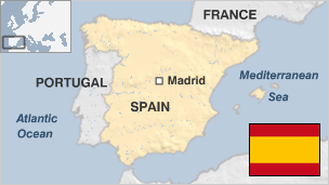
Spain is the largest of the two countries that comprise the Iberian Peninsula, and also the most significant. It borders three nations - France (623km) and Andorra (63.7km) to the north, and Portugal (1,214km) to the west. However, it also borders the UK thanks to the British Territory of Gibraltar (1.2km) on its southern tip, and Morocco on mainland Africa, through the autonomous Spanish cities of Ceuta (6.3km) and Melilla (9.6km).

Borders:

Andorra 63.7 km, France 623 km, Gibraltar 1.2 km, Portugal 1,214 km, Morocco (Ceuta) 6.3 km, Morocco (Melilla) 9.6 km

Population:

46,148,605

GDP per capita:

$33,647.98 per capita

Capital with population:

Madrid - 2,947,228

Largest city with population:

Madrid - 2,947,228

Alternative names:

Spain, Kingdom of Spain, Espana


Top Rankings


Bottom Rankings


COMPARE Spain TO THESE COUNTRIES:

Maps of Spain

Spain - Land Utilization
Spanish and Portuguese Settlements in America
Spanish Kingdoms 1030 A.D.
Spain and Portugal
Spain and Portugal
(View 32 more maps)

Popular articles

Lists and articles

   
SPANISH STATS
QUIZZES
 

COMMENTARY     

momyty
25th April 2011
Great Website!
phottoshop
26th April 2009
DOWNLOAD ADOBE ACROBAT - $59.95 >>> CLICK HERE DOWNLOAD NOW
Casey
24th April 2009
Yeah, free galicia, the basque country, valencia, and catalonia and let them all stop with the nonsense and come crying back in a year begging for money, protection and resources. you got the good life, stop complaining.
Julio Cortes (Mexico)
11th April 2007
Latins are Portuguese, Spaniards, and Italians. Latinos are people of Latin American descent. A Hispanic is one who speaks either Spanish or Portuguese. Doesn't anyone get it? http://en.wikipedia.org/wiki/Talk:European_American#Mediterranean.2FMiddle_Eastern_Ethnicity
Vincent Bettencourt USA
29th November 2005
I m just a Portuguese, but a proud one. I m not any better or worse than any other group, but I am Portuguese.

I would think that if you are proud of being Portuguese, you would not even entertain the thought of having your heritage sidelined for terminology meant to assign a non derogatory term which would be accepted by the mestizo/mulatto population of the Latin American countries since they are not Caucasians, Indians, or Black in most part, due to the mingling of the racial lines over the last few hundred years.

Someone in Portugal sent me some information on hispanic terminology and Lusitania which I found interesting and will paste below.

It is very offensive to me to be considered a hispanic, latino or anything other than European, Portuguese, Lusitanean.

Culturally we do not have anything in common with the hispanics nor the latinos other than that the brasilians speak portuguese and spanish colonies speak spanish which has a common tie in old vulgar latin.

Heres is the information that I spoke of above:

Hispanic
adj.
1. Of or relating to Spain or Spanish-speaking Latin America.
2. Of or relating to a Spanish-speaking people or culture.
n.
1. A Spanish-speaking person.
2. A U.S. citizen or resident of Latin-American or Spanish descent.
[Latin Hisp?nicus, from Hisp?nia, Spain.]
USAGE NOTE Though often used interchangeably in American English, Hispanic and
Latino or Latin are NOT identical terms, and in certain contexts the choice between them can be significant. Hispanic, from the Latin word for Spain, has the broader reference, potentially encompassing all Spanish-speaking peoples in both hemispheres and emphasizing the common denominator of language among communities that sometimes have little else in common. Latino, which in Spanish means "Latin" but which as an English word is a shortening of the Spanish word latinoamericano-refers more exclusively to persons or communities of Latin American origin. Of the three, only Hispanic can be used in referring to Spain and its history and culture; a native of Spain residing in the United States is a Hispanic, not a Latino, and one cannot substitute Latino in the phrase the Hispanic influence on native Mexican cultures without garbling the meaning. The term Latin (Latium: origin of the original Latins in Italy) applies only to persons from the European romance language countries such as France, Italy, Spain, Romania, and Portugal.
However, the term should really not be used because it tries to assimilate the different customs, traditions and ethnic groups of all the areas conquered by the Romans into one category, which is highly inaccurate and fails to take into
account the cultural and linguistic differences between them. In addition,
these labels totally ignore what existed in the areas of conquest prior to the Roman Empire. In practice, however, this distinction is of little significance when referring to residents of the United States, most of whom are of Latin American origin and can theoretically be called by either word Hispanic or Latino. A more important distinction concerns the sociopolitical rift that has opened between Latino and Hispanic in American usage. For a certain segment of the Spanish-speaking population, Latino is a term of ethnic pride and Hispanic a label that borders on the offensive. According to this view, Hispanic lacks the authenticity and cultural resonance of Latino, with its Spanish sound and its ability to show the feminine form Latina when used of women. Furthermore, Hispanic-the term used by the U.S. Census Bureau and other government agencies-is said to bear the stamp of an Anglo establishment far removed from the concerns of the Spanish-speaking community. Latin refers to any of the people related to, or descended from, the original Latin-speaking Romans, and includes all the Romance-speaking European nationalities Romanian, French, Italian, Spanish, Portuguese, including their cultures, and their descendants worldwide. Hispanic, on the other hand, specifically refers to Spain and the Spanish-speaking nations of the Americas as cultural and demographic extension of Spain. Meanwhile, Latinos are only those from the countries of Latin America, whether Spanish or Portuguese-speaking. The confusion that arises is from the similarity between the words Latino and Latin, and between the concept of Hispanic and Latino. Latino is a shortened version of the Spanish noun latinoamericano and is used for the inhabitants of Latinoamérica (Latin America). In the Spanish language "Latín" (Latin) is the name of the language of the Romans, and as such is not confined solely to Hispanics and Latinos. Thus, of a group consisting of a Brasialian a Spaniard and a Romanian; the Brazilian, Colombian, and Mexican would all be Latinos, but not the Spaniard or the Romanian, since neither Spain nor Romania are geographically situated in Latin America. Conversely, the Colombian, Mexican and Spaniard would all be Hispanics, but not the Brazilian or the Romanian, since Brazil was conquered and founded by the Portuguese, and neither Portugal or Romanian are extensions of Spain. The one exception for a Brazilian to be considered Hispanic is if his ancestry was Spanish rather than Portuguese. Finally, all of the above nationalities would all be Latin, including the Romanian. Aside from "Hispanic", "Latino", and "Latin", other terms are used for more specific subsets of the Hispanic population. as well as excluding all other recent immigrants of various other races and nationalities now residing in Latin America. Also disregarded is whether or not those excluded groups now use Spanish as their first and only language - as is the case with all Blacks, most Native Americans and many recent immigrants. This Latin American use of the term is more so evident in addresses regarding affairs of indigenous and African descended peoples made by government and minority agencies, where the creole, mestizo and mulatto collective majority and Difficulties and criticisms on the U.S. application of Hispanic are based on the US goverment having problems identifying the Latin Americans by what they really
are: Mestizos, blacks, mulattos and Indians, and white european caucasians. In order not to offend these groups, they have created the Hispanic/Latino-Americano labels, and these have changed over the years. In order for them to be successfull at this menagerie of labels, they need to be inclusive and demean the Spaniards and others into categories of less than European/Caucasians. Hispanic, as the term is defined and used in the United States, encompasses a very diverse population which often makes efforts toward creating a Pan-Hispanic sense of identity difficult. While in the United States Hispanics are often treated as a group apart from "whites", "blacks" and other racial.
Since Spain is in Europe and all indigenous Spaniards belong to the Caucasian race, they should not be included in the Hispanic category, being that in the United States, Hispanic is designated as a "minority group. In the United States, a great proportion of Hispanics identify as mestizo or mulatto, partly because most of Latin America is of this mixed ancestry (European, Black, and Indigenous people) regardless of national origin and they constitute majority populations in most Latin American countries. Some other Hispanics may be of unmixed Spanish ancestry, predominantely those from Uruguay and Argentina, or of relatively unmixed Spanish ancestry, not uncommon amongst Costa Ricans.
Some may also be of unmixed Native American Indian ancestry, many of those from Bolivia Peru, and a noticeable proportion of those from Mexico, while many Hispanics of Dominican, Puerto Rican, Cuban and Colombian backgrounds may be mulatto or of unmixed black African ancestry. However, the presence of these mentioned races and race-mixes are not country-specific, since they can be found in every Latin American country, whether as larger of smaller proportions of their respective populations. Cultural trends Popular culture varies widely from one Hispanic community to another, despite this, several features tend to unite Hispanics from diverse backgrounds. Many Hispanics, including U.S.-born second and third generation Hispanics, use the Spanish language to varying degrees. The most usual pattern is monolingual Spanish usage among new immigrants or older foreign born Hispanics, complete bilingualism among long settled immigrants and their children, and the use of Spanglish and colloquial Spanish within long established Hispanic communities by the third generation and beyond. In some families the children and grandchildren of immigrants speak mostly English with some Spanish words and phrases thrown in.


Music
Folk and popular dance and music also varies greatly among Hispanics. While many people speak of "Latin" music as a single genre, Latin America is home to a wide variety of music. Hispanic Caribbean music tends to favor complex polyrhythms of African origin. Mexican music, depending on region, shows combined influences of Spanish, Native American and African origin, while the traditional Tejano music of Mexican-Americans is more influenced by country-and-western music and the polka, brought by central European settlers to Texas. Meanwhile, native Andean sounds and melodies are the backbone of Peruvian and Bolivian music, but also play a significant role in the popular music of most South American countries and are heavily incorporated into the folk music of Ecuador and Chile and the tunes of Colombia, and again in Chile and Argentina where they play a fundamental role in the form of the greatly followed nueva cancion, Latin pop, rock and ballad styles tend to appeal to the broader Hispanic population, and varieties of Cuban music are popular with many Hispanics of all backgrounds. Cuisine There is also no single stereotypical Hispanic cuisine. Traditional Mexican, Cuban, Spanish, Argentinian and Peruvian cooking, for example, all vary greatly from each other, and take on new forms in the United States. While Mexican cuisine is the most familiar variety of "Hispanic food" in most of the United States, it is not representative of the cuisine of most other Hispanics. The cuisine of Mexico can be heavily dependent on staples such as maize and is greatly indebted to the cuisine and diet of the Aztec and Maya. Cuba, on the other hand, may be dependent on starchy root vegetables and is influenced by the flavours of Africa. The cuisine of Spain is very different from its neighbors and even further apart from the Latin American former colonies.
Meanwhile, Argentina relies almost exclusively on red meats, consuming almost everything derived from beef, and is heavily influenced by Italian cuisine are popular as a source of meat (derived from the diet of the Incas, and staples indigenous to the region, such as maize and the myriad of potato varieties, are the most utilised there. Rice also plays an important role in peruvian cuisine. This diversity in staples and cuisine is also evident in the differing regional cuisines within the national borders of the individual countries. Most groceries in heavily Hispanic areas carry a wide array of specialty Latin American products, in addition to the widely available brands of tortillas.


Lusitania (l?s?t?n'??) : An ancient area in the Iberian Peninsula. The province took its name from the Lusitani, a group of warlike tribes who, despite defeats, resisted Roman domination until their great leader, Viriatus, was killed (139 B.C.) by treacheryThe identification of Portugal with Lusitania and of the ancestors of the Portuguese with the Lusitanians (hence Camões's great epic was entitled Os Lusíadas) is historically correct. Lusitania existed prior to the Roman conquest. This is the true heritage of the Portuguese and anything less is considered an insult to their heritage.

Lusitanians
The Lusitani may have come from the Alps and established themselves in the region in the 6th century BC.

Roman province
With Lusitania (and Asturias and Gallecia, Rome had completed the conquest of the Iberian Peninsula (not known as hispania yet) which was then divided by Augustus (25-20 BC) into the southwesternHispania Baetica, and the western Provincia Lusitana. Originally Lusitania included the territories of Asturia and Gallaecia, but these were later ceded to the jurisdiction of new HispaniaTarraconensis and the former remained as Provincia Lusitania et Vettones. Notice that Iberia was divided by the Romans into two Hispania provinces in addition to Lusitania. These two Hispanias later became disintigrated into a variety of countries which merged over time and finally in
1497 or so became Spain. In contrast Lusitania became the birthplace of
Portugal with battles in 1127, the first major battle of Sao Mamede on 24 June
1128, and recognition by Leon in 1143. The actual date of
formation/declaration of independence for Portugal is the battle of Sao Mamede 1128. Portugal's formation preceded Spain by a few hundred years.
Alex Cortes
31st August 2005
J.P. I have to let you that Portuguese culture is in fact Hispanic. The term Hispanic was created from the name Hispania given to the Iberian peninsula by the Romans when they conquered it. To be more specific it was Hispania Ulterior and Hispania Interior. Hispania Ulterior referred to those people who spoke the language derived from Gallego which is Portuguese. Portugal's name derives from the Roman name Portus Cale (Latin for Warm Port) Cale was the name of an early settlement located at the mouth of the Douro River, which flows into the Atlantic Ocean in the north of what is now Portugal. Around 200 BCE, the Romans took the Iberian Peninsula from the Carthaginians during the Second Punic War, and in the process conquered Cale and renamed it Portus Cale. During the Middle Ages, the region around Cale became known by the Visigoths as Portucale. Portucale evolved into Portugal during the 7th and 8th centuries, and by the 9th century, the term "Portugale" was used extensively to refer to the region between the rivers Douro and Minho, the Minho flowing along what would become the northern border between Portugal and Spain. The term Hispanic has absolutely nothing to do with the mixing of races between native indeginous and Spaniards. The terms used for interracial mixing are as follows: Mestizo=European/Native American Indian, Mulatto=European/Black African, Zambo=Native American Indian/Black African, Mazumbo=European/Native American Indian/Black African. Also for the record the term Hispanic can be anyone of any race who shares language and culture. Please fell free to reply my e-mail address is acortes7771@gmail.com
dev
25th August 2005
Does anyone know the holidays Spain celebrates?
Angy
14th March 2005
Does any one know how old Spain is?
Al Sosa
21st January 2005
Thank you Steven Colosi for bringing to my attention that Albanians speak a language derived from their ancient Illyrian ancestors.
Al Sosa
19th January 2005
Thank you. Steven Colosi for bringing to my attension, that Albanians speak a language derived from their ancient Illyrian ancestors.
Al Sosa
19th January 2005
Thank you, Steven Colosi for bringing to my attension, that Albanians speak a language derived from their ancient Illyrian ancestors.
laurebt
27th November 2004
whatis the absolute location,relative location,area of spain?
There are 70 more (non-authoritative) comments on this page

Share your thoughts, questions and commentary here
Your name
Your comments

Want to know more?
Search encyclopedia, statistics and forums:


Lesson Plans | Student Area | Student FAQ | Reviews | Press Releases |  Feeds | Contact
© Copyright NationMaster.com 2003-2013. All Rights Reserved. Usage implies agreement with terms, 1022, m